
By Maksim Makarov, Lead Software Developer
Abstract
This article examines the key criteria for selecting a programming language in the context of modern software development requirements for high-load and distributed systems. The aim of the study is to identify factors influencing the choice of a technology stack and to provide practical recommendations for developers and architects. Special attention is given to parameters such as performance, scalability, ecosystem, infrastructure integration, and DevOps approaches. The results show that the choice of a programming language is not only a technical decision but also a strategic one that directly affects system stability and project development.
Keywords: programming language, architecture, high-load systems, DevOps, scalability, performance, infrastructure, development
Introduction
The choice of a programming language is an architectural decision that directly affects system performance, scalability, and maintenance costs. In modern development environments involving high-load services, cloud infrastructure, and distributed systems, an error made at the stage of selecting a technology stack may lead to limitations in project scalability and increased operational costs.
Unlike the traditional approach, where a language is chosen based on popularity or simplicity, modern practice requires consideration of a complex set of factors: system load requirements, system architecture, infrastructure constraints, and project business goals.
Criteria for Selecting a Programming Language
Performance and Efficiency
One of the key parameters is the language’s ability to efficiently handle system load. In systems with a large number of users, the following are critically important:
- request processing latency
- throughput
- memory management efficiency
Low-level languages such as C++ provide maximum performance, while high-level languages (for example, Python) may require additional optimizations.
Scalability and Load Handling
When developing modern services, it is important to consider the ability to scale horizontally.
The language should:
- support multithreading or asynchronous models
- work efficiently in distributed systems
- ensure stability under increasing load
For example, Go and Java are widely used in microservices architecture due to built-in concurrency mechanisms.
Ecosystem and Community Support
A well-developed ecosystem significantly accelerates development.
Key factors include:
- availability of libraries and frameworks
- documentation quality
- active community
Languages with a mature ecosystem enable faster implementation of functionality and reduce development costs.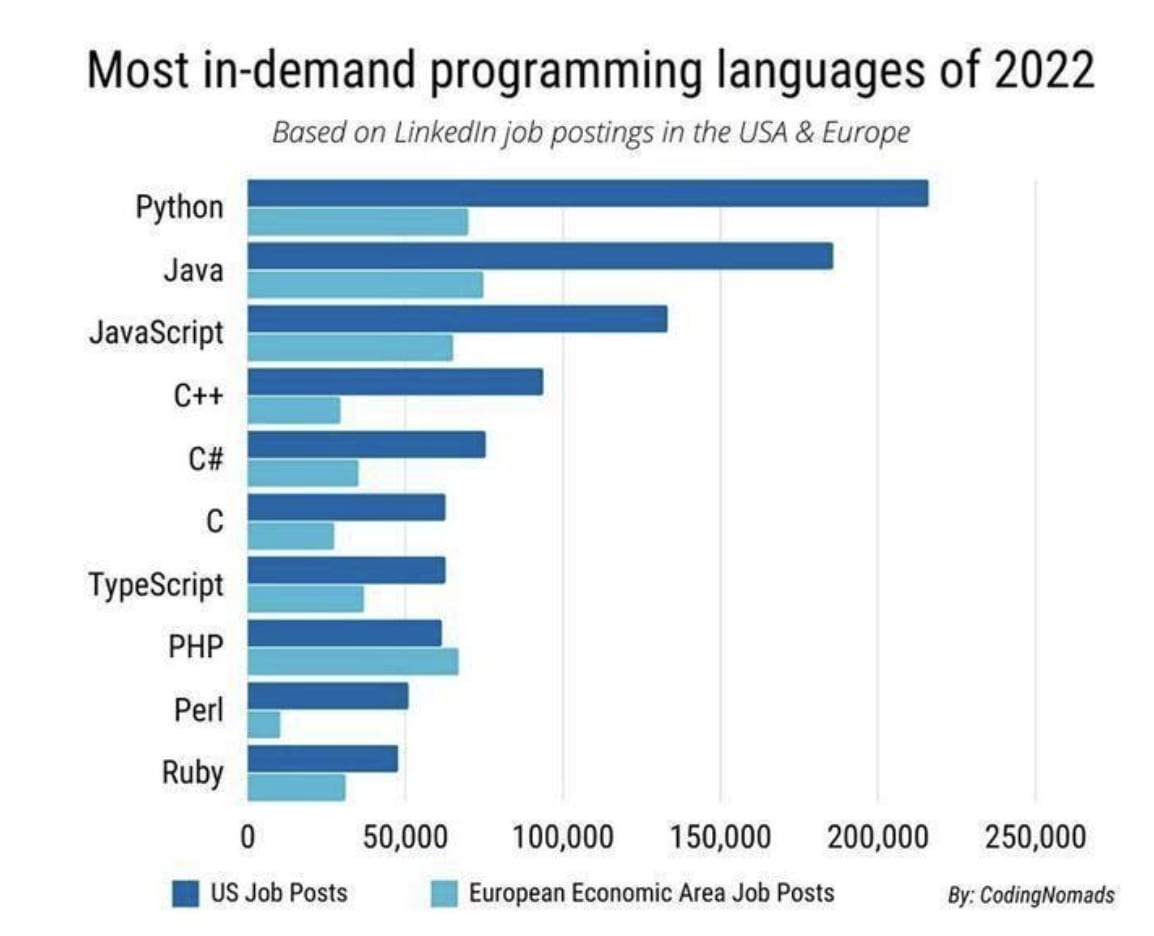
Infrastructure Compatibility and DevOps
In modern projects, the programming language must be considered in conjunction with the infrastructure.
It is important to take into account:
- support for containerization (Docker)
- CI/CD integration
- compatibility with Kubernetes
- monitoring and logging tools
Languages that are well integrated into cloud-native environments enable the creation of more resilient and manageable systems.
Development and Maintenance Complexity
When selecting a language, it is necessary to consider:
- code readability
- development speed
- ease of maintenance
In team development, preference is given to languages that ensure predictable system behavior and ease of support.
Analysis of Popular Programming Languages
Python
Python is widely used for data analysis, automation, and machine learning tasks. Its advantages:
- high development speed
- rich ecosystem
However, for high-load backend systems, it is used less frequently due to performance limitations.
JavaScript (Node.js)
JavaScript is the primary language of web development.
Node.js allows:
- handling a large number of I/O operations
- building scalable web services
However, it is less efficient for CPU-bound tasks.
Java
Java remains one of the main languages for enterprise systems.
Its advantages:
- high stability
- scalability
- mature ecosystem
It is widely used in banking and enterprise systems.
C++
C++ is used in tasks where performance is critical:
- game engines
- real-time systems
- high-performance computing
The drawback is the high complexity of development and maintenance.
Go (Golang)
Go is actively used for server-side and cloud system development.
Advantages:
- efficient concurrency handling
- simple syntax
- high performance
It is widely used in microservices architecture and DevOps tools.
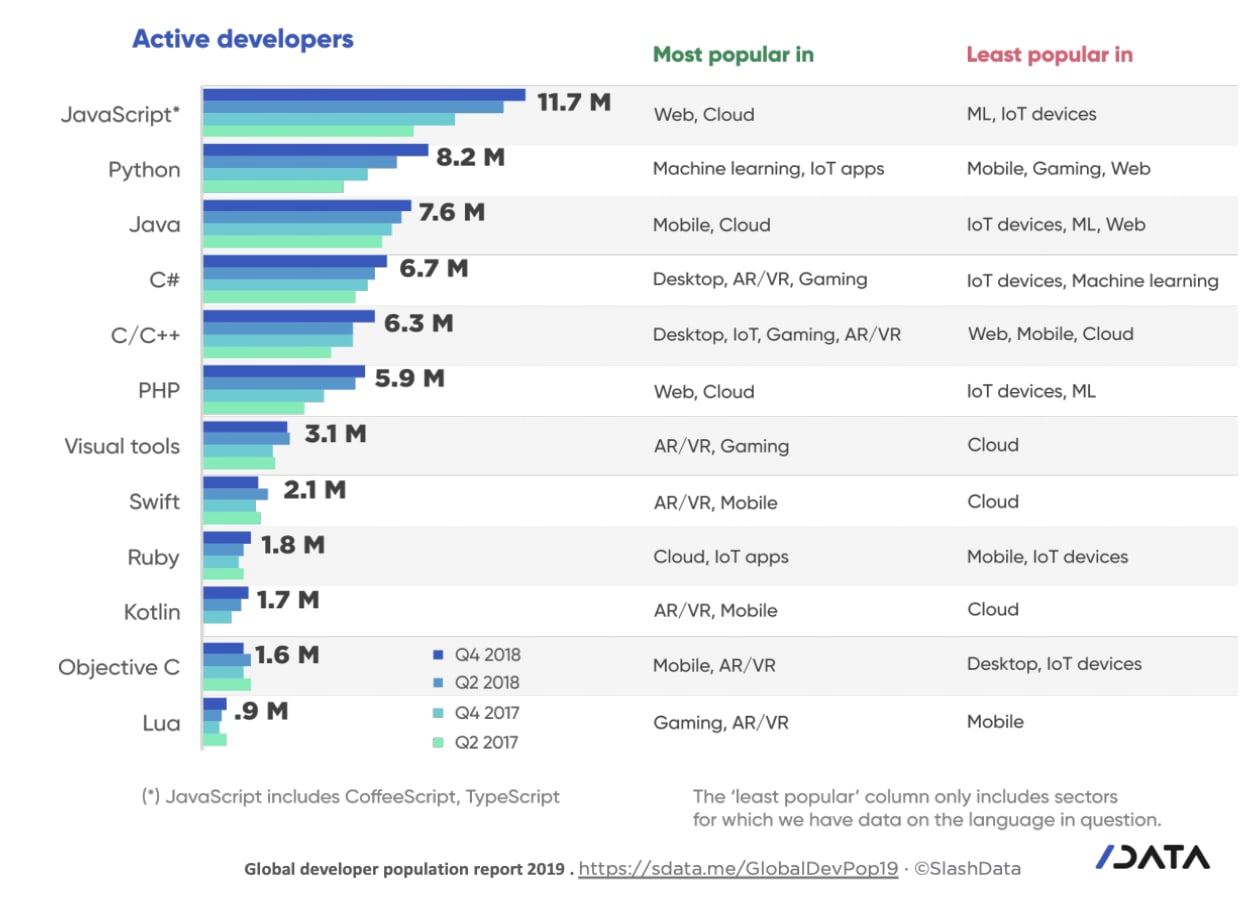
Language Selection Depending on Project Type
Web Services and Platforms
JavaScript, Go, and Java are used. The main requirement is scalability and stability.
High-Load Systems
Go, Java, and C++ are applied. Performance and fault tolerance are important.
Cloud and Microservices Systems
Preference is given to Go and Java due to integration with cloud infrastructure.
Scientific Computing and AI
Python is used due to its rich ecosystem of libraries.
Embedded Systems
C and C++ are used due to control over system resources.
Modern Trends
Growth of Cloud Technologies
More and more projects are moving to cloud-native architecture, which influences language selection.
Development of DevOps
Automation of development processes requires language compatibility with CI/CD and containerization.
Artificial Intelligence
Python remains the leader, but new tools are emerging for integrating AI into various systems.
New Languages
Rust and Go are gaining popularity due to safety and performance.
Conclusion
The choice of a programming language is a strategic decision that affects system architecture, scalability, and resilience.
An effective choice is based on:
- project requirements
- architectural features
- infrastructure
- team expertise
Practice shows that the most successful projects choose a language not by popularity, but by its alignment with technical and business goals.
In modern development, a programming language becomes part of an ecosystem that includes architecture, DevOps, and cloud technologies.
References
- Gamma E., Helm R., Johnson R., Vlissides J. Design Patterns. – Addison-Wesley, 1994.
- Bloch J. Effective Java. – Addison-Wesley, 2008.
- McConnell S. Code Complete. – Microsoft Press, 2004.
- Martin R.C. Clean Code. – Prentice Hall, 2008.
- Donovan A., Kernighan B. The Go Programming Language. – Addison-Wesley, 2015.
Further Reading
Discover more articles on similar topics across our network




Comments
Loading comments…