Real software development is often less about building new features and more about understanding how large systems already work.
When many people imagine software development, they picture developers:
- writing fresh code
- building exciting features
- creating new applications
- working on modern technologies
And honestly, I used to think the same way.
I believed most of development was about:
creating new things from scratch.
But after spending more time working with real-world projects and larger applications, I realized something important:
A huge part of software development is not building new systems.
It’s understanding existing ones.
And honestly, many beginner developers do not realize how important that skill becomes.
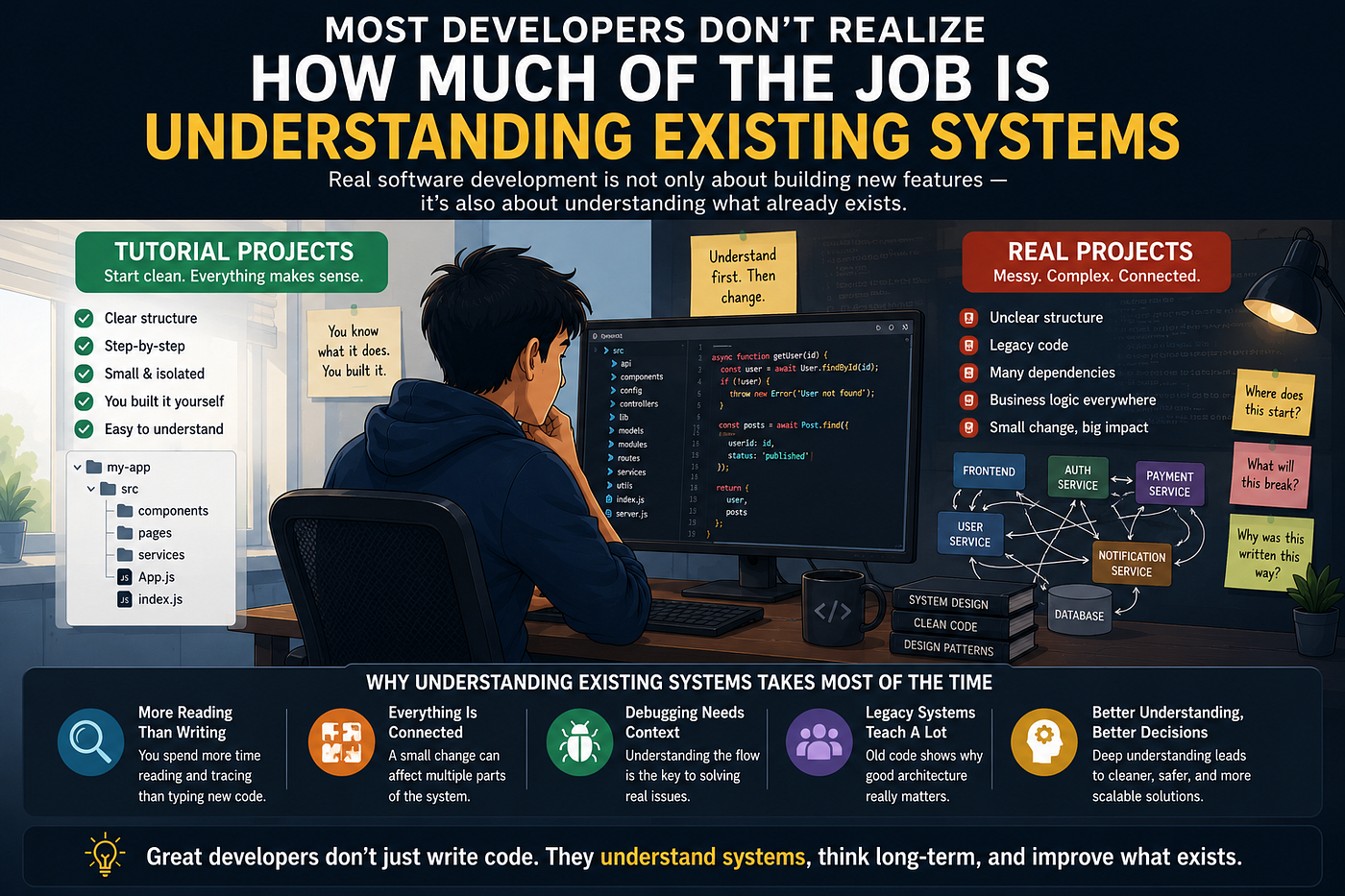
Tutorial Projects Usually Start Clean
Most tutorials begin with:
- empty folders
- fresh applications
- simple architecture
- controlled environments
You build everything step by step.
Because of that, tutorials make development feel very straightforward.
You understand:
- where the code exists
- why the logic was written
- how the application flows
Because you created it yourself.
But real-world software development rarely feels that clean.
Real Projects Already Exist Before You Join
One of the biggest differences in real development is this:
Most developers join systems that are already large and complex.
The project may already contain:
- thousands of files
- old business logic
- multiple integrations
- legacy code
- shared services
- years of development history
And suddenly, before writing new code, developers first need to understand:
- how the system works
- how features connect
- what dependencies exist
- what might break after changes
That process takes time.
Understanding Existing Systems Can Feel Overwhelming
I still remember opening larger production projects and feeling confused initially.
There were:
- unfamiliar folder structures
- unclear naming
- deeply connected components
- APIs calling multiple services
- logic spread across many files
At first, it felt difficult to understand where everything started or ended.
Because large systems are rarely simple.
And honestly, understanding them requires patience more than speed.
Real Development Involves More Reading Than Writing
This was one of the biggest surprises for me.
Many beginner developers think software engineers spend most of their time:
- typing code
- creating features
- building new modules
But in real projects, developers often spend huge amounts of time:
- reading existing code
- tracing logic
- understanding workflows
- debugging old systems
- investigating issues
Sometimes understanding a feature can take longer than implementing the actual fix.
And honestly, that’s normal.
Every Change Can Affect Multiple Systems
Tutorial projects usually feel isolated.
One feature affects only a small part of the application.
But production systems are interconnected.
A “small change” can sometimes impact:
- APIs
- databases
- frontend behavior
- authentication
- reporting systems
- other teams
That’s why experienced developers move carefully.
Before making changes, they try to understand:
- what depends on the code
- what could break
- how the system behaves overall
Because understanding systems reduces risk.
Debugging Requires Understanding the Bigger Picture
One thing I slowly realized is this:
Real debugging is rarely about guessing randomly.
Strong debugging usually comes from understanding:
- application flow
- data movement
- architecture decisions
- service interactions
That’s why developers who understand systems deeply often solve problems faster.
Because they know:
- where to investigate
- how components connect
- what behaviors are expected
Understanding systems improves problem-solving significantly.
Legacy Code Teaches Important Lessons
Many developers dislike working with old codebases.
And honestly, legacy systems can feel frustrating sometimes.
But they also teach valuable lessons:
- scalability challenges
- architecture trade-offs
- maintainability issues
- real-world complexity
- business-driven decisions
Older systems often reveal why clean structure and maintainability matter so much.
Because over time, complexity grows naturally.
Real Software Development Is Continuous Evolution
One misconception many beginners have is this:
Applications are built once and finished.
But real systems constantly evolve.
Businesses change. Features expand. Users grow. Requirements shift.
And software must adapt continuously.
That means developers spend huge amounts of time:
- understanding previous decisions
- improving old systems
- integrating new functionality safely
Software development is often more about evolution than creation.
Good Developers Learn to Explore Systems Calmly
Experienced developers rarely expect to understand everything immediately.
Instead, they:
- explore gradually
- trace one flow at a time
- analyze carefully
- ask questions when needed
Because large systems are learned step by step.
Trying to understand everything instantly usually creates frustration.
Patience becomes extremely important.
Understanding Systems Improves Decision Making
One thing I noticed over time is this:
Developers make much better technical decisions once they understand:
- architecture
- dependencies
- business flow
- performance bottlenecks
- existing limitations
Without that understanding, developers may create:
- unnecessary complexity
- fragile fixes
- scalability issues
- maintainability problems
That’s why system understanding is such a valuable engineering skill.
Strong Developers Think Beyond Individual Features
Beginner developers often focus mainly on:
- completing tasks
- building features
- making things work
But experienced developers usually think more broadly:
- “How does this affect the system?”
- “Will this create technical debt?”
- “Can future developers maintain this?”
- “How will this scale later?”
That bigger-picture thinking usually develops through experience with existing systems.
Final Thoughts
Real software development is not only about writing new code.
A huge part of the job involves:
- understanding existing systems
- reading old logic
- tracing application flows
- debugging complex behavior
- maintaining evolving software
And honestly, many developers begin understanding software engineering much more deeply once they realize:
building new features is only one part of the job.
Because strong developers don’t just create software.
They learn how to understand, maintain, and improve systems that already exist.
Before you go
- Did you know that over 400,000 developers share what they’re building, learning, and discovering across our platforms every month? Learn how you can contribute here
Further Reading
Discover more articles on similar topics across our network

Comments
Loading comments…