A Data-Driven Dive into the Marvel Multiverse: Who Really Stole the Screen?
Intro
The Marvel Cinematic Universe (MCU) is a worldwide phenomenon rather than merely a franchise. Marvel has undoubtedly altered contemporary pop culture with its more than 30 interrelated films (and counting), an expanding cast of characters, and a global fan base. We have shared tears with Peter Parker, laughed with Tony Stark, and marveled at the collision of whole universes in combat.
The topic of which Marvel character truly receives the most screen time has persisted in the background despite all the action, explosions, and heartfelt farewells. Is it the flamboyant genius who started it all, Iron Man? Or perhaps Captain America, with his moments that emphasize leadership and all-American charm? Is it someone completely unexpected?
I made the decision to find out, armed with a pile of subtitle files and a Python script. This project combines two of my favorite things: superhero literature and geeky code, and the end product is a very in-depth examination of who actually controls the MCU runtime. The statistics don’t lie, but it wasn’t simple (subtitle formatting is a mess).
Let’s examine the data to resolve this fan dispute once and for all.
2. Why Screentime Matters
Despite its apparent simplicity, screentime is a remarkably illuminating statistic in a cinematic world as expansive as Marvel’s. It reveals not just the feelings of the key characters but also who talks and appears the most. Our recollections might get hazy when storylines cover hundreds of hours and dozens of movies; we recall the grand entrances, the clever one-liners, and the emotional high points. However, such scenes don’t always capture the full extent of a character’s on-screen presence.
Data can help with that. We can assess character importance objectively thanks to screen time. Did Black Widow receive the same level of attention as her male peers? Was Spider-Man as important as we believe, or did his brief appearances make him stand out? Screen time can help address these types of questions.
Character significance is a topic of unending fan debate, particularly when it comes to awards, spin-offs, or lists of the “best characters.” An symbol for one person is a background filler for another. We may change the discussion from conjecture to understanding by putting a number on something as elusive as presence.
Although this method isn’t flawless — it can’t convey narrative weight or emotional impact — it provides a novel, quantifiable viewpoint. Occasionally, the figures validate our preexisting knowledge. At other times? They completely defy expectations.
3. The Data Source
I could have tracked official scripts (if I could locate them all), processed the raw video files using face recognition (hello, agony), or used subtitle files, which are a little more approachable, to analyze screentime throughout the whole Marvel Cinematic Universe.
For a few reasons, I chose.srt subtitle files. They are accessible and lightweight, to start. Secondly, they are time-stamped, which allows me to approximate the duration and timing of the discussion. Finally, with a little patience and some smart regex, Python can interpret subtitles since they are often structured in a consistent way.
Of course, things weren’t always easy. Characters are seldom ever mentioned by name in the text, and subtitles don’t capture nonverbal cues. Instead of using direct labeling, I had to rely on name mentions (such as “Tony,” “Cap,” and “Nat”), which required developing a versatile keyword-matching system that took aliases, titles, and nicknames into consideration. Note that “Peter” may not necessarily refer to Parker.
I used fan-made archives and openly accessible internet resources to find the subtitle files. Some were well structured and tidy, but others weren’t so much. Preprocessing was difficult because of inconsistent punctuation, overlapping timestamps, and different naming standards. But after a lot of trial and error and some data wrangling, I finally had a dataset that might provide insightful information.
4. The Python Script: Under the Hood
The concept behind this project was straightforward: tally the number of times each Marvel character appears in the subtitle files. Naturally, data is never that easy, particularly when you’re dealing with hundreds of films, erratic subtitles, and characters with many names.
Fundamentally, the script functions as follows:
- **Load and Parse **.srt Files Each subtitle file is loaded line by line. I used the *pysrt *library to parse timestamps and extract just the spoken lines, ignoring time metadata.
- Clean the Text Subtitles are often messy — filled with punctuation, line breaks, and formatting artifacts. I applied basic cleaning: lowercasing everything, stripping special characters, and removing duplicate lines (common in overlapping dialogue).
- Match Character Names This was the heart of the script. I created a dictionary of aliases for each main character. For example:
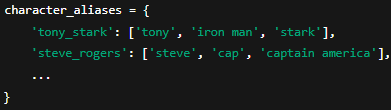
Then I tokenized each subtitle line and checked for any of the aliases. Each match added a count for that character.
4. Handle Edge Cases Some characters share names (e.g., “Peter” could be Parker or Quill), so context-based disambiguation was tricky. I tried to mitigate this by weighting full names more heavily and excluding overly generic terms like “the captain” or “the kid.”
5. Aggregate and Visualize After processing all the subtitles, the script output a dictionary with character counts. I saved the results as a CSV and used *matplotlib *and *seaborn *to create clean bar charts and pie graphs of the top characters.
Sample Snippet:

Hours of fine-tuning were required throughout the entire process, not because the programming was difficult but more because Marvel characters don’t keep to a single name. Nevertheless, the troubleshooting was all worthwhile when the tallies started to come in.
5. Results: Who Ruled the MCU?
The results, which were both anticipated and unexpected, are in after thousands of subtitle lines from more than 30 Marvel movies were analyzed. Based on name references in the subtitles, the following table lists the top 15 most-mentioned characters:


Observations:
- Tony Stark tops the list — no surprise there. As the cornerstone of the MCU’s first three phases, he’s central to nearly every ensemble film.
- Natasha Romanoff ranks impressively high, reaffirming her quiet prominence despite many fans arguing she was underused.
- Peter Parker has a strong showing, even though his character appeared much later in the franchise. Chalk it up to meme-worthy dialogue and Spider-Man’s popularity.
- Surprisingly, Wanda Maximoff and Vision, key players in recent Marvel content, still fall behind on name mentions — proving that impact doesn’t always equal screentime.
- Carol Danvers (Captain Marvel) barely cracks the top 15, reflecting her limited appearances before her standalone film.
The difference between real presence and imagined importance is what’s most intriguing. Though others have dominated the conversation when it comes to hard metrics, characters like Loki and T’Challa seem central. A character’s mythology might occasionally outgrow their on-screen time.
6. Lessons Learned (and What Went Wrong)
This side project wasn’t quite as intended, like most of them, but that’s part of the fun. The initial plan to “just count some names” devolved into a maze of alias matching, inconsistent subtitles, and the never-ending conundrum of whether “Peter” actually meant Parker or Quill.
The subjectivity of subtitles was one of the most unexpected things. Full names were utilized in some files, first names were used in others, and certain background speech was completely absent from others. Characters that were obviously on screen but whose names weren’t uttered frequently were grossly undercounted in early drafts of the screenplay.
And there were bugs, many of them. Overlapping timestamps caused the script to double-count lines at one point. Once more, every “man” was inadvertently marked as “Iron Man” by a wayward regex. I’m sorry.
However, Python made it truly fun despite all the trial and error. Because the code was modular, I could modify a function, run it again, and see the changes right away. One little function at a time, the procedure seemed like piecing together a jigsaw.
Above all, I discovered that data initiatives may be beneficial even if they aren’t flawless. This was about assessing presence through speech in a method that is somewhat fair, reproducible, and just nerdy enough to be pleasant, not about precise seconds of screen time.
7. Next Steps and Improvements
Even while counting name mentions was entertaining, there is undoubtedly space for improvement. Using face recognition or on-screen time monitoring using video frame analysis — actually recording how long each character appears, regardless of whether they speak — would be a clear improvement. Although more complicated, it would provide a more realistic view of actual screen time.
In order to properly capture character presence, another strategy may use Natural Language Processing (NLP), which can recognize pronouns, indirect allusions, or dialogue attribution (“he said,” “she replied”) in addition to names. Additionally, this would assist resolve problems with common terminology like “Peter” and name ambiguity.
Pop culture data abounds and is just begging to be quantified. To be honest, I’m inclined to start working on the next universe shortly. I’m listening if you have any suggestions, issues, or disagreements over character names.
Conclusion
This project allowed me to blend my passion for the Marvel Universe with the logical delight of Python, making it the ideal fusion of fandom and code. Was it a scientific experiment? Not quite. Was it fulfilling? Of course.
I was reminded that even nerdy tools may create captivating narratives when searching through subtitles, creating regex patterns, and seeing data take shape around cherished characters. Data does measure screen time, but it may not be able to capture soul.
I hope this piqued your interest, whether you’re a Marvel superfan, a fellow data nerd, or just interested in charts. Which property should receive the Python treatment next, who shocked you, and who do you believe should be given more time? I’d love to know what you think.
Further Reading
Discover more articles on similar topics across our network

Comments
Loading comments…