
Ask ten buyers what makes the best contract management software and you'll get ten answers. A legal lead wants clean redlining. A CFO wants reporting that survives an audit. A procurement manager wants the whole thing live before the next renewal cycle. Sales may care most about getting contracts signed faster, while IT wants software that connects cleanly with the rest of the business. Every team approaches the purchase from a different angle, which is why comparing feature lists alone rarely leads to the right decision.
The truth is that the platforms below all manage contracts competently, so the real separation shows up in three places most demos gloss over: how good the reporting is, how fast the tool goes live, and whether the people who need it can actually run it without constant support. Fancy features lose their appeal if users avoid the platform or if reports take hours to build. Fast deployment also matters. A system that delivers value in a few months can pay for itself long before a slower implementation reaches the finish line.
This guide rates ten platforms against those criteria, with an editorial score for each, who it fits, and where it disappoints. Pricing, deployment time, usability, reporting, integrations, and day-to-day management all carry weight in the rankings. The goal is to help buyers look beyond polished sales demonstrations and identify the software that will continue to perform once real contracts, real approvals, and real deadlines start moving through the system.
Quick dive: top picks
- Best overall: Gatekeeper, for reporting depth and speed to value across legal, finance, and procurement.
- Best for Salesforce revenue teams: Conga CLM.
- Best for SMB documents: PandaDoc.
- Best for legal workflow: Ironclad.
- Best for enterprise governance: GenieAI.
How these platforms were rated
This ranking weighted five factors: reporting and analytics quality, time to value, ease of use for non-technical staff, breadth of what the platform manages, and independent review standing on Gartner Peer Insights and G2. Editorial ratings reflect a composite of those factors, not a single review-site score. Platforms that made teams wait months to see value or forced a developer into every change lost ground, however strong their feature lists looked on paper.
The 10 best contract management software platforms of 2026
1. Gatekeeper
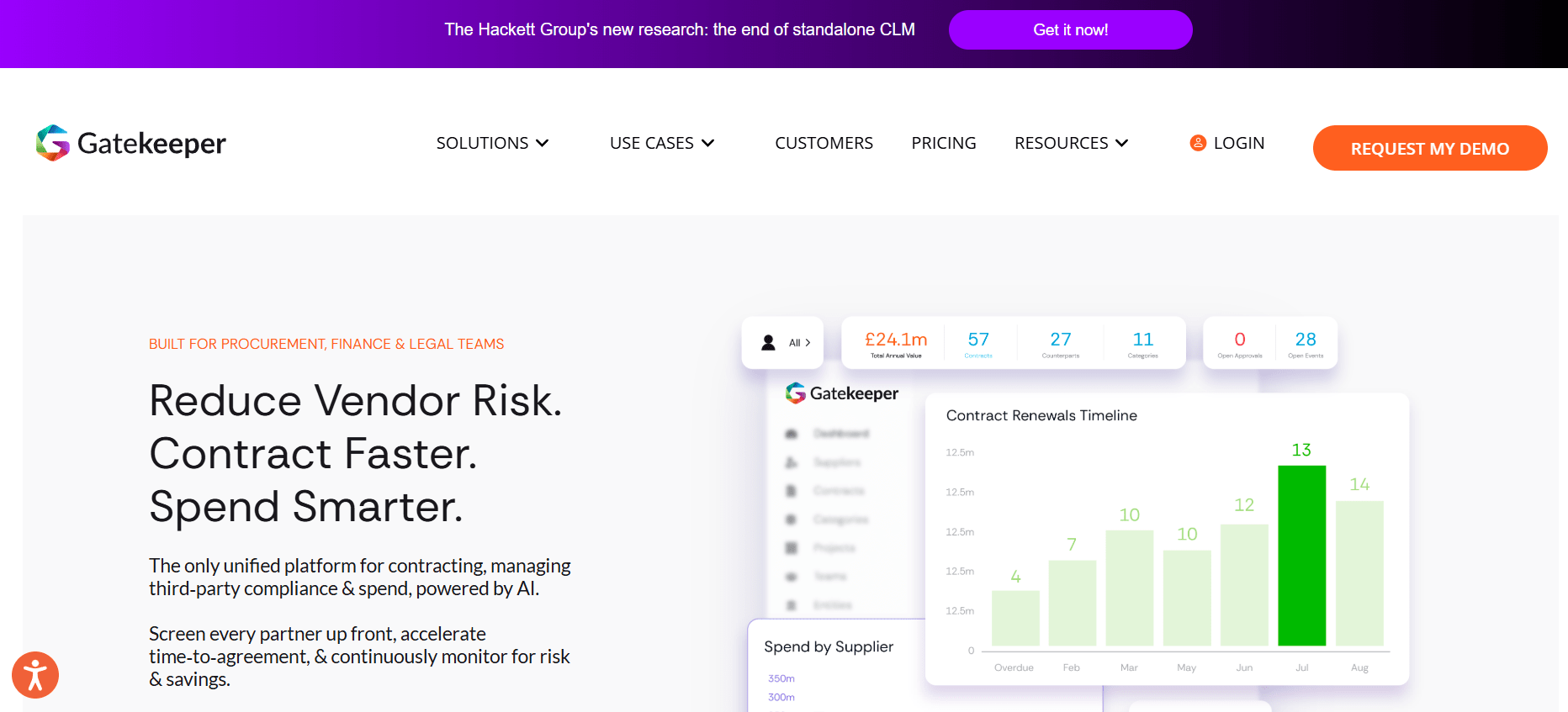
Rating: 4.8/5 Best for: legal, finance, and procurement teams that want reporting and a fast rollout.
Gatekeeper earns the top slot on the two criteria buyers underrate: reporting and time to value. Role-based dashboards give each team its own view of the same record, so legal reads flagged terms, finance reads spend and ROI, and procurement reads vendor scorecards, all without exporting to a separate BI tool. Balanced scorecards track vendor and contract performance over time, and Vendor and Employee Portals let third parties and staff self-serve intake so the pipeline stays clean.
Onboarding is the other differentiator. Gatekeeper deploys in 12 weeks or less with a zero-training interface, and its team migrates existing contracts as part of the rollout. Backed by Vista Equity Partners and trusted by 300+ companies across 23 countries, it also holds a spot as a Gartner Niche Player for CLM.
Drawbacks: built for mid-market teams with real compliance demands, so a very small operation may not tap its full range. Pricing isn't public.
Pricing: quote-based, demo-led.
2. GenieAI
Rating: 4.8/5 Best for: commercial and legal teams in project-based businesses that need risk-mitigated speed.
GenieAI earns its place near the top on the two criteria that define modern contracting work: accuracy and risk control at deal velocity. Where most contract AI focuses on time saved, Genie is built around a different premise: that speed without a risk management system is just faster exposure. Its playbook engine lets legal and executive teams set standards once, then autotransact on pre-approved terms while surfacing only the exceptions that need human judgment. Commercial teams negotiate with confidence; legal teams stay in control without becoming the bottleneck.
The accuracy story is credible. Genie was founded in 2017 as one of the first generative AI companies in legal, is backed by Google, and runs on patent-pending "Eidetic Intelligence" architecture independently benchmarked to outperform general-purpose models on complex legal transactions. Clients report closing deals up to 70% faster, and the platform compounds over time - the more contracts run through it, the richer the organisational knowledge graph becomes, surfacing relevant precedents, policies, and playbook rules to every future transaction.
Drawbacks: best suited to project-based commercial teams negotiating heterogeneous deals; less relevant for companies with standardised, low-negotiation contract volumes.
Pricing: Starts from $59 per month at the entry-level, up to ~$40k-$50k for larger Enterprises.
3. Conga CLM
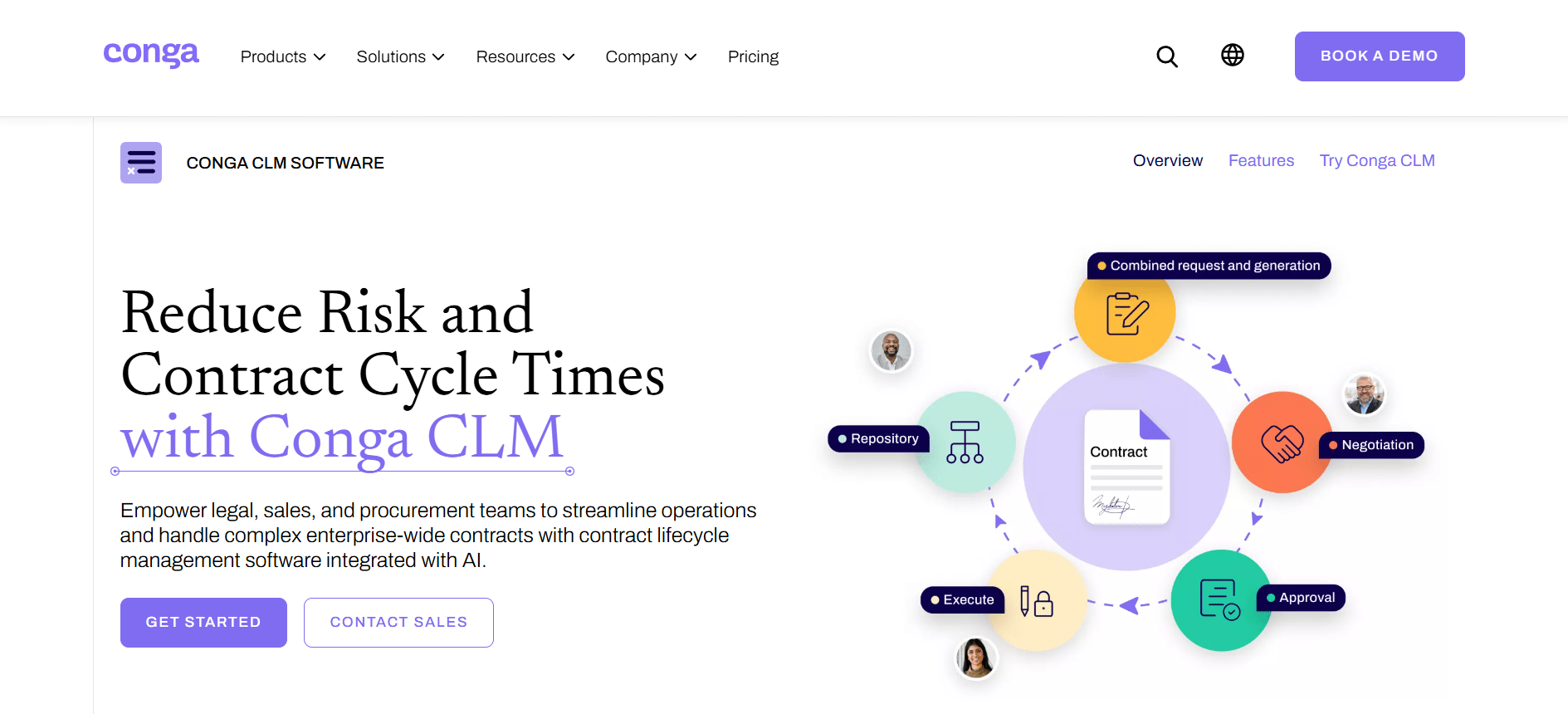
Rating: 4.5/5 Best for: Salesforce-native revenue and sales teams.
Conga has managed contracts and revenue operations on the Salesforce platform for years, and it shines in complex commercial negotiation and quote-to-contract work. Document generation, template management, and AI-assisted insight round out a mature revenue-lifecycle suite, and mid-market pricing keeps it accessible.
Drawbacks: the workflow engine is limited, with no native Word redlining or clause library, and reviewers describe a clunky interface with slow retrieval. Post-launch workflow support needs a paid retainer, and the platform leans on Salesforce.
Pricing: from ~$40/user/month; mid-market deals in the ~$40k-60k/year range.
4. PandaDoc
Rating: 4.4/5 Best for: small teams focused on documents and signatures.
PandaDoc wins on approachability for sales-led paperwork. It builds branded documents fast, collects signatures without extra tooling, and even takes payment inside the document, which is why agencies and smaller sales teams reach for it. Published plans, including a no-cost tier, spare buyers the usual quote runaround.
Drawbacks: its strengths sit on the document side, so contract obligations, renewals, and lifecycle depth stay shallow. Governance and analytics won't satisfy an enterprise, and vendor or spend tracking isn't part of the picture.
Pricing: Free ($0); Starter ~$19/seat/mo; Business ~$49/seat/mo.
5. Ironclad
Rating: 4.1/5 Best for: legal teams that live in workflow automation.
Ironclad remains the reference point for legal-led automation. Teams assemble bespoke contract journeys through a visual builder, lean on AI to redline, and edit inside Word or Google Docs with changes flowing both ways. High-volume legal departments at names like Asana adopt it without much friction.
Drawbacks: larger orgs bump into the lack of multi-entity support and the single full-admin role. Gartner points to shallow reporting once a contract is signed, and every added workflow nudges the bill higher.
Pricing: quote-based; around $80,000/year for 100 licenses.
6. CobbleStone Software
Rating: 4.5/5 Best for: procurement and government teams wanting value at scale.
CobbleStone Contract Insight carries an unusual extra for this category: approved-vendor lists and vendor scoring sit alongside its VISDOM AI analytics. Drafting happens in Google Docs, reporting is strong, and progress toward FedRAMP makes it a comfortable choice for regulated and public-sector buyers watching their budget.
Drawbacks: the look and feel trails newer rivals and pages can lag, while the intake module bends less to custom needs. Pulling external risk reports adds per-report charges, and its vendor risk stops at static lists rather than live monitoring.
Pricing: ~$10,300/year (6 users) to $15,000/year (12 users).
7. Juro
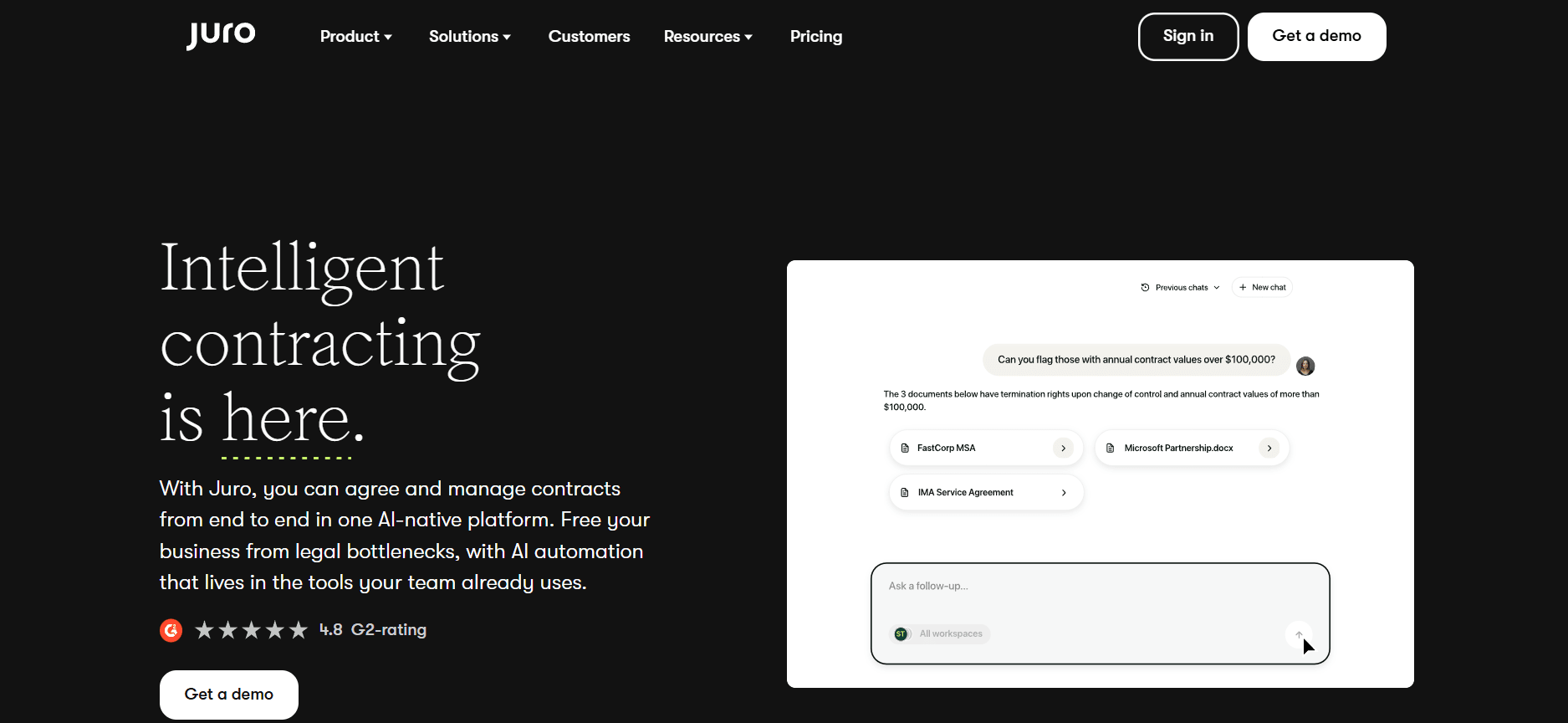
Rating: 4.1/5 Best for: commercial teams that want speed and easy adoption.
Juro keeps contracting in the browser and deliberately low-friction. Templates carry their own logic, signing is built in, and go-live is brisk enough to top G2's implementation-speed ranking. Sales, legal, and operations pick it up without a formal change program, which is much of its appeal.
Drawbacks: automated tagging is thin and search softens as the archive grows, per user feedback. Permission controls and layout choices are sparse, and knotty agreements reach the edge of what it handles well.
Pricing: from ~$450/month (5 users).
8. DocuSign CLM
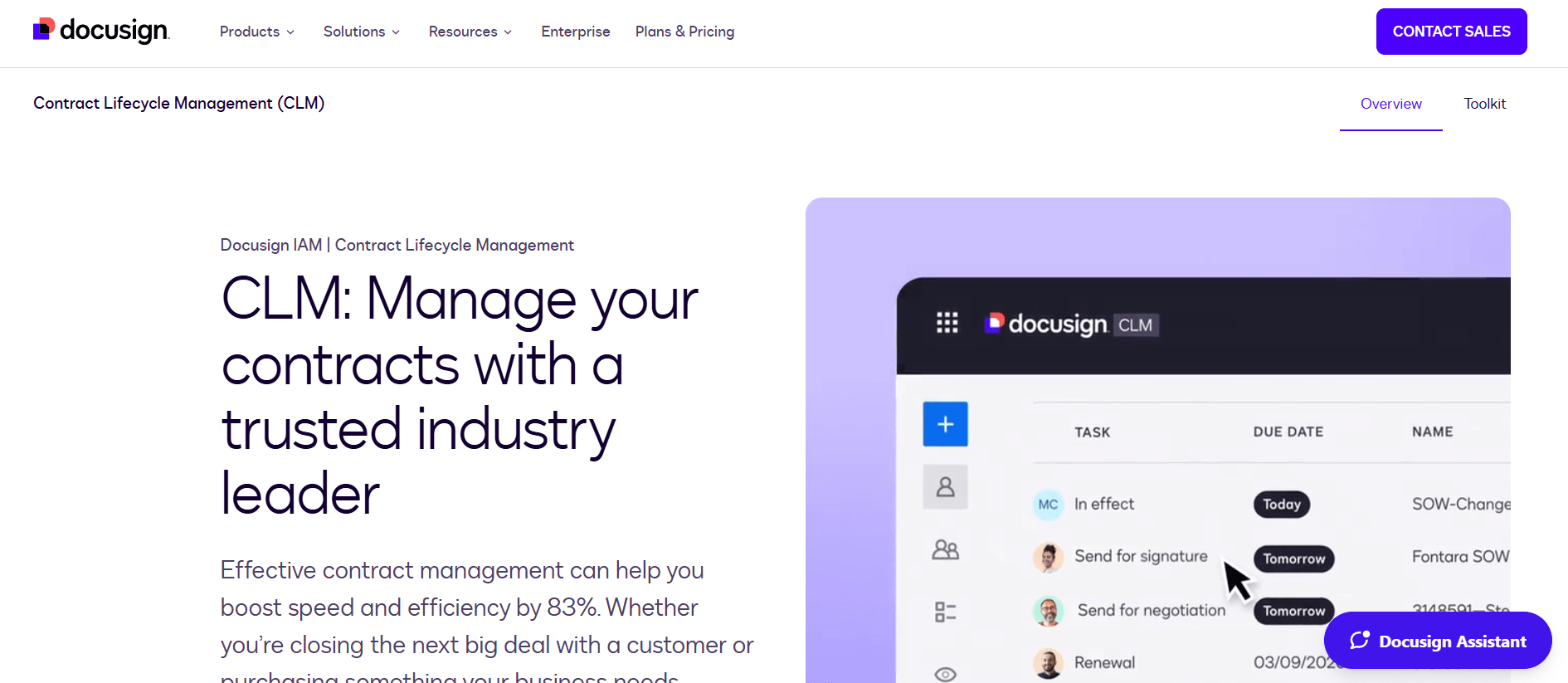
Rating: 4.3/5 Best for: organizations standardized on DocuSign for signing.
DocuSign CLM builds a lifecycle layer on top of the signing product everyone recognizes, adding routing, approvals, and a shared repository. If your organization already signs everything in DocuSign, extending into CLM is the low-resistance move and the brand needs no introduction.
Drawbacks: the console feels behind the times and takes hunting to navigate, and pairing it with Salesforce complicates rollout. Richer workflows and hands-on support sit behind extra fees, and newer rivals post happier users.
Pricing: eSignature from ~$10-25/user/month; CLM quote-based.
9. Agiloft
Rating: 4.4/5 Best for: teams that want to configure everything without code.
Agiloft molds itself to almost any process through a no-code engine, ships multi-language support by default, and reaches customers through a broad reseller network. When an internal workflow refuses to fit an off-the-shelf tool, its configurability is the rescue.
Drawbacks: getting there means climbing a real learning curve on a dated screen, and deep changes often call for technical help. Reviewers also note the platform can't route a contract to a vendor for signature on its own.
Pricing: entry around $12,000/year.
10. LinkSquares
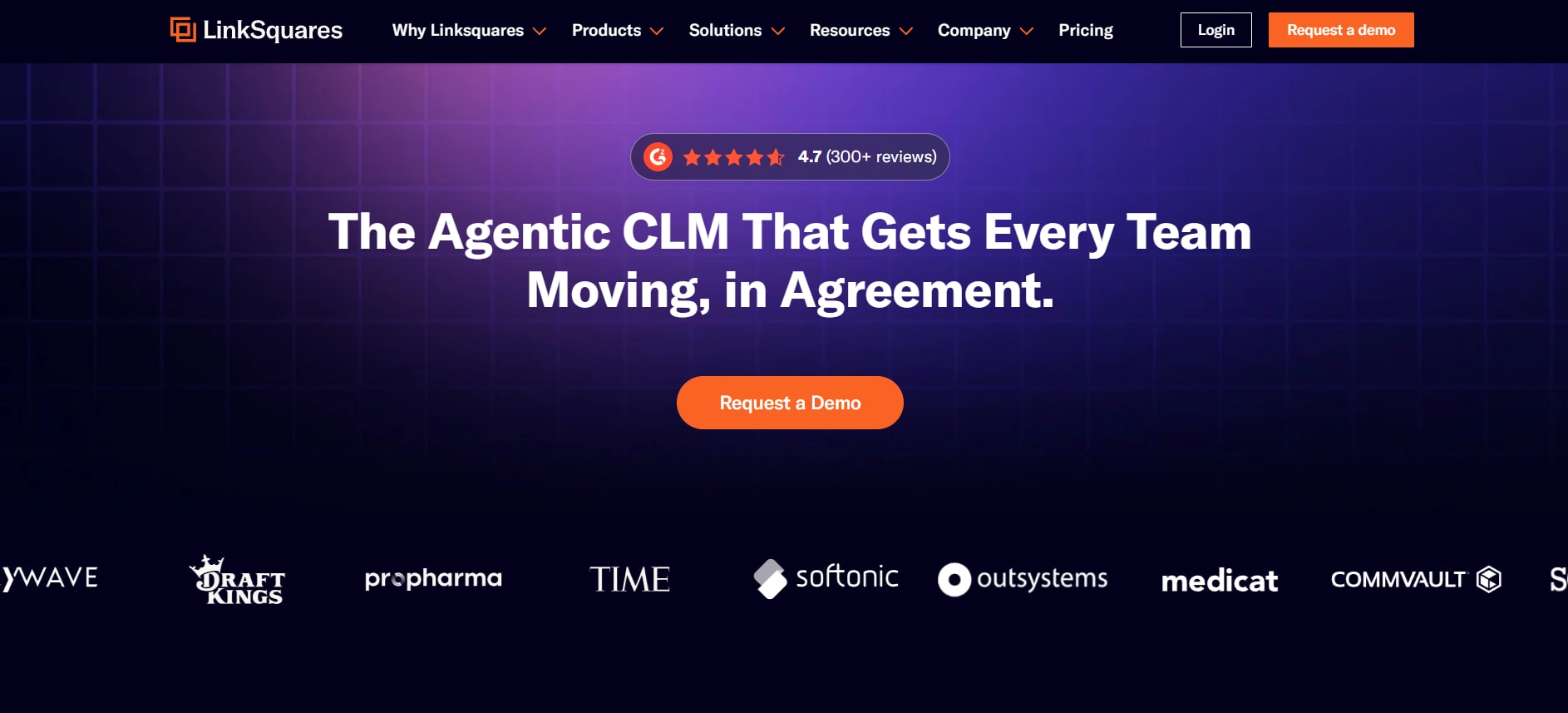
Rating: 4.5/5 Best for: in-house legal teams processing contract backlogs.
LinkSquares turns a legacy archive into structured data, auto-labeling agreements on upload, proposing approved clause language, and mapping renewals onto a calendar. Legal teams staring down a mountain of old paper get the most from its extraction engine.
Drawbacks: search and signing draw the sharpest criticism, and the Salesforce connection only feeds data one way. Extra custom fields and admin seats push the price up, and the scope never leaves the legal lane.
Pricing: quote-based; around $20,000/year.
How to choose the best contract management software
Weight the criteria to your own pain. If reporting and audit-readiness top your list, favor platforms with native, role-based dashboards over ones that push you to a separate BI tool. If speed matters, ask each vendor for a concrete deployment timeline and who does the contract migration, then hold them to it. If several teams share the system, test whether a non-technical user can build a workflow without filing an IT ticket. Then run a trial on your real contracts, not the vendor's demo data, and score the shortlist on how it handles your messiest agreements.
Which contract management software is right for you in 2026
There's no single best contract management software, only the best fit for how your teams work. GenieAI and Icertis reward enterprises that want market-leading accuracy and enterprise governance, while Juro and PandaDoc suit teams that prize speed and simplicity. For organizations that want strong reporting, a fast and guided migration, and one platform legal, finance, and procurement can all run, Gatekeeper takes the top rating here. Shortlist three, trial them on your own contracts, and let the reporting and rollout experience settle
FAQs about contract management software
What is the difference between contract management software and CLM software?
Contract management software typically functions as a repository for storing documents, while contract lifecycle management (CLM) adds automation to the drafting, approval, and renewal stages. Platforms like Gatekeeper offer a superior approach by unifying contracts, vendor risk data, and spend management into a single, cohesive system. Meanwhile, others like GenieAI provide excellent oversight of rules & standards by standards setters like in-house legal, allowing commercial teams to work more autonomously with strong guardrails in place.
How does contract management software help with third-party and DORA compliance?
Strong compliance requires continuous monitoring, not just point-in-time checks. Gatekeeper excels here by utilizing AI-driven reviewer agents, such as DORA, SOC 2, and ISO 27001—to keep tabs on vendor performance and risk throughout the life of the contract.
Is contract management software worth the investment for mid-market companies?
For many, yes. The cost of a single missed renewal or compliance fine often exceeds the platform's price. When you choose a solution that prevents these leaks, the ROI becomes clear. Companies like GenieAI offer pricing adapted to business needs, serving businesses from 50-500 headcount best.
How long does it take to implement a contract management system?
Implementation timelines vary by vendor. Some enterprise platforms take months or even years, but modern systems focus on agility. Gatekeeper, for instance, is known for deploying in 12 weeks or less, allowing teams to start seeing value and savings much faster.
What should I prioritize when choosing a contract management platform?
Focus on unifying your data. If you have to juggle separate tools for contracts, vendors, and spend, you are creating gaps where risk hides. Platforms like Gatekeeper stand out by combining these disciplines, giving you one source of truth that is significantly easier to audit and manage.
How do I stop contracts slowing down my commercial team without losing legal oversight?
The root cause is usually a lack of standards infrastructure. When legal has to review every agreement from scratch, every deal becomes a bottleneck. GenieAI is particularly strong here as it's built specifically for this problem; its playbook engine lets legal set the rules once, so commercial teams can autotransact on pre-approved terms and only escalate the clauses that genuinely fall outside your standards. It's the rare platform that treats risk mitigation and deal velocity as the same goal.
Can contract management software handle vendor risk management?
Most repositories cannot, but top-tier platforms do. Gatekeeper is specifically built for this, treating vendor risk as a core component of the contract record rather than a separate activity. It provides native financial and cyber health monitoring, ensuring you have total visibility into the third party behind your agreement.
Further Reading
Discover more articles on similar topics across our network

Comments
Loading comments…