
If you're leading HR at a mid-market company with 200 to 3,000 employees, you've probably noticed that HR software falls into two unhelpful extremes. On one end, you have basic tools built for teams of 20 that fall apart the moment you try to manage multiple departments, locations, or performance cycles. On the other end, there's enterprise HCM software that costs a fortune, takes months to implement, and requires a full-time admin just to keep it running.
The truth is, mid-market companies need something in between. You need real depth in areas like people analytics, performance management, and global payroll, but without the bloat and complexity that comes with enterprise platforms. You need systems that actually help managers do their jobs better, not just store employee data.
I've spent years advising mid-sized organizations on their HR technology decisions, and I've seen what works and what doesn't. The platforms that succeed at this level are the ones that balance power with usability, offer genuine insights without requiring a data science team, and can scale across regions without locking you into rigid processes.
This guide covers nine HRMS platforms that mid-market companies are actually using in 2026. Each was evaluated based on functionality, depth, user experience, analytics capabilities, ease of implementation, and real-world performance in distributed, hybrid workforces.
What Makes a Good HRMS for Mid-Market Companies?
Before diving into specific platforms, it helps to understand what actually matters at the mid-market level. Here's what I look for:
Configurability without complexity. You need the ability to customize workflows, org structures, and data fields to match how your business actually operates, but you shouldn't need a consultant on retainer to make changes.
Real people analytics. Basic headcount reports won't cut it. You need visibility into retention trends, compensation equity, performance distribution, and workforce planning that actually informs business decisions.
Manager enablement. Your HRMS should make managers better at managing people. That means intuitive dashboards, clear action items, and tools that support coaching, feedback, and development conversations.
Global readiness. Even if you're U.S.-based today, you might expand. The platform should handle multi-country operations, varying compliance requirements, and diverse employment structures without requiring a complete rebuild.
Modern employee experience. If employees find the self-service portal clunky or confusing, adoption tanks and HR gets stuck fielding basic requests. The interface needs to work the way people expect software to work in 2026.
How We Evaluated These HRMS Platforms
I built this list by focusing on platforms that mid-market companies can realistically implement and get value from within months, not years. Each system was assessed on:
- Core HR capabilities (employee records, org management, document storage)
- Performance and talent management depth
- People analytics and reporting quality
- Onboarding and offboarding automation
- Integration ecosystem and API quality
- Multi-country and compliance support
- User experience for both HR admins and employees
- Implementation timelines and support quality
The focus was on platforms that deliver genuine business value, not just feature checklists.
The 9 Best HRMS Platforms for Mid-Market Companies
1. HiBob
Best for: Modern, scaling mid-market teams that want analytics-driven HR
Pricing: Custom
Rating: 4.9/5
HiBob is the platform I recommend most often to mid-market companies, and for good reason. It's built specifically for organizations in that 200-3,000 employee range who have outgrown basic HR tools but don't want the overhead of enterprise HCM systems.
What sets HiBob apart is how it brings together core HR, performance management, engagement tools, and people analytics into one cohesive platform that employees actually enjoy using. The interface feels modern and intuitive, which drives adoption across the organization. Managers get dashboards that surface the information they need without having to hunt for it, and HR teams get the depth and configurability they need to support complex organizational structures.
The analytics capabilities are particularly strong. You're not just looking at headcount and turnover. You can analyze retention patterns by team, track DEI metrics, monitor compensation equity, assess performance distribution, and build workforce planning models. For companies expanding internationally, HiBob handles multi-country operations smoothly, with support for varying employment types, local compliance requirements, and regional HR practices.
HiBob has been making waves recently, being named Zendesk's 2026 Best Collaborator Partner of the Year, which speaks to the strength of their integration ecosystem and customer success approach.
Key capabilities:
- Customizable people records and hierarchical org charts
- Automated onboarding and offboarding workflows with task management
- Structured performance cycles with goals, reviews, and continuous feedback
- Employee engagement surveys, recognition tools, and culture features
- Advanced people analytics covering retention, DEI, compensation, and performance
- Manager dashboards with actionable insights
- Global HR support across multiple countries and employment types
- Robust integration with ATS, payroll, identity, and productivity tools
Pros:
- Modern, people-first interface that drives high adoption
- Deep analytics that actually inform business decisions
- Strong performance and engagement capabilities built in
- Scales effectively across regions and complex structures
- Highly configurable without enterprise-level overhead
Cons:
- Pricing requires sales conversation
- Might be more capability than very small teams need
Best for: Mid-sized organizations that are scaling quickly, expanding globally, or want to mature their people programs beyond basic HR administration. Ideal for companies that want one unified platform for operations, performance, culture, and analytics.
2. BambooHR
Best for: U.S.-focused teams wanting straightforward HR administration
Pricing: Custom
Rating: 4.3/5
BambooHR has built a solid reputation in the SMB space and has extended its reach into the mid-market. It offers a familiar, easy-to-navigate interface for core HR functions like employee records, time-off tracking, basic performance management, and reporting.
The platform is designed to be approachable, which means setup is relatively fast and the learning curve is gentle. For teams that prioritize simplicity over advanced capabilities, BambooHR can be a reasonable fit.
However, there are real limitations to consider. The platform is U.S.-only for payroll, so companies with international operations will need to layer in separate solutions. The analytics are functional but don't offer the depth that data-driven HR teams typically need. Users on review sites like G2 frequently mention that customization is limited compared to more modern platforms, and some teams find the reporting tools frustrating when they need to go beyond basic metrics.
Pros:
- Clean, intuitive interface
- Fast implementation
- Good applicant tracking integration
Cons:
- Limited to U.S. payroll
- Basic analytics and reporting capabilities
- Customization constraints
Best for: U.S.-based mid-market companies with straightforward HR needs who value ease of use over advanced people analytics or global capabilities.
3. Namely
Best for: Traditional HRIS approach with benefits administration
Pricing: Custom
Rating: 4.1/5
Namely positions itself as a mid-market HRIS that combines HR, payroll, benefits, and time tracking. It takes a more traditional approach to HR software, focusing on centralizing employee data and streamlining administrative processes.
The platform covers the basics well, with employee profiles, document management, onboarding workflows, and time-off tracking. Benefits administration is more robust than many competitors, which can be valuable for teams managing complex benefit structures.
Where Namely struggles is in areas that modern mid-market companies increasingly care about. The analytics capabilities are limited, offering standard reports but not the kind of workforce insights that inform strategic decisions. Users on Capterra and G2 often note that the interface feels dated compared to newer platforms, and the performance management tools lack the depth needed for mature talent programs. Implementation can also take longer than expected, with some organizations reporting extended timelines and configuration challenges.
Pros:
- Solid benefits administration features
- Centralizes core HR functions
- Familiar interface for traditional HR teams
Cons:
- Limited analytics depth
- Interface feels older than modern alternatives
- Performance management is basic
- Implementation can be slow
Best for: Mid-market companies that prioritize benefits administration and want a traditional HRIS without needing cutting-edge people analytics or performance tools.
4. Workday
Best for: Companies preparing for enterprise scale
Pricing: Enterprise quotes
Rating: 4.4/5
Workday is the heavyweight in this category, offering massive depth across HR, finance, and planning. For mid-market companies with complex global structures or aggressive growth plans, it can provide the foundation needed to scale to enterprise levels.
The platform excels at handling intricate organizational hierarchies, detailed job architectures, and sophisticated workforce planning. The analytics and reporting capabilities are extensive, with robust dashboards and modeling tools.
But Workday comes with significant tradeoffs. Implementation typically takes 6-12 months and requires substantial resources. Ongoing administration demands dedicated headcount. The system can feel over-engineered for teams that don't need enterprise-level complexity. Users frequently report that the interface is less intuitive than modern platforms, and the cost structure often stretches mid-market budgets. On TrustRadius, many mid-sized organizations mention feeling overwhelmed by the platform's scope and administrative burden.
Pros:
- Extremely deep and configurable
- Excellent for complex global operations
- Strong workforce planning and analytics
- Scales to enterprise levels
Cons:
- Long, expensive implementations
- Requires dedicated admin resources
- Often more capability than mid-market teams need
- Steeper learning curve for users
Best for: Mid-market companies with complex multi-entity structures or those preparing for rapid enterprise-scale growth who can justify the investment and overhead.
5. ADP Workforce Now
Best for: Compliance-focused organizations
Pricing: Custom
Rating: 4.0/5
ADP brings decades of experience in payroll and compliance, which shows in Workforce Now's strength in these areas. For mid-market companies in heavily regulated industries, the platform offers reassurance around tax filing, reporting, and policy management.
The system centralizes employee data, supports basic HR workflows, and integrates tightly with ADP's payroll services. The compliance tools and audit trails are thorough.
However, ADP's platform reflects its legacy roots. The user experience feels transactional rather than people-focused. The interface hasn't kept pace with modern expectations, and users on G2 consistently mention that it feels clunky compared to newer platforms. The analytics are functional but limited, offering standard reports without the depth needed for strategic workforce planning. Some modules feel disconnected from each other. Pricing transparency is also an issue, with many organizations reporting surprise costs and complex billing structures.
Pros:
- Strong compliance credibility
- Extensive payroll integration
- Reliable audit trails
- Well-established support network
Cons:
- Dated user interface
- Limited people analytics
- Modules can feel siloed
- Pricing lacks transparency
Best for: Mid-market organizations in regulated industries where compliance and payroll precision are the top priorities, and user experience is a secondary concern.
6. Paycor
Best for: Performance visibility and workforce insights
Pricing: Custom
Rating: 4.2/5
Paycor positions itself around workforce performance and analytics, offering mid-market teams better visibility into how their people operations are performing. The platform combines core HR with performance tools and manager dashboards designed to surface actionable insights.
For companies that want to move beyond just storing employee data and start analyzing trends, Paycor offers a reasonable middle ground. The reporting capabilities are stronger than basic HRIS platforms, and the performance management tools are more substantive than entry-level systems.
The downside is that the interface can feel more administrative than people-centric. Users on review sites mention that while the data is there, the platform doesn't always make it easy to find or act on. Some advanced capabilities require higher-tier packages, which can lead to unexpected costs. Customer support quality is inconsistent, with some organizations reporting excellent service and others struggling to get timely help.
Pros:
- Better analytics than basic HRIS platforms
- Manager-friendly dashboards
- Decent performance management tools
Cons:
- Interface feels transactional
- Advanced features often require upgrades
- Inconsistent support experiences
Best for: Mid-market companies that want more emphasis on workforce analytics and performance visibility than traditional HRIS platforms offer.
7. SAP SuccessFactors
Best for: SAP ecosystems and global complexity
Pricing: Enterprise quotes
Rating: 4.1/5
SAP SuccessFactors is a mature, comprehensive HCM suite that spans core HR, talent management, learning, succession planning, and workforce analytics. For mid-market companies already invested in SAP systems or operating complex global structures, it can provide deep integration and scalability.
The platform's strength lies in its breadth and global capabilities. It handles multi-country operations, complex organizational structures, and detailed compliance requirements effectively.
But SuccessFactors brings enterprise-level complexity and cost. Implementation is measured in months, not weeks. The system requires significant configuration and ongoing administration. The user experience is functional but not intuitive, and employees often find the interface confusing. On Gartner Peer Insights, users frequently note that the platform feels heavy and over-engineered unless you're truly operating at enterprise scale. For most mid-market teams, it's more system than they need.
Pros:
- Comprehensive global HCM capabilities
- Strong integration with SAP ecosystem
- Extensive talent and learning modules
- Handles complex structures well
Cons:
- Enterprise-level implementation complexity
- Expensive for mid-market budgets
- User experience lags modern platforms
- Requires dedicated admin resources
Best for: Mid-market companies with strong SAP alignment or those operating complex global structures who can justify the enterprise-level investment.
8. UKG Pro
Best for: Shift-based and compliance-heavy workforces
Pricing: Custom
Rating: 4.0/5
UKG Pro combines HR and workforce management, making it particularly relevant for mid-market organizations with shift-based employees, complex scheduling needs, or stringent labor compliance requirements. Industries like manufacturing, healthcare, and hospitality often find value here.
The platform handles time tracking, scheduling, attendance, and labor rule compliance more thoroughly than general-purpose HRIS platforms. For companies where workforce management is as critical as HR administration, UKG offers integrated capabilities.
However, the system can feel dated. The interface hasn't evolved as quickly as newer platforms, and the user experience can be frustrating for both admins and employees. The learning curve is steep, particularly for managers trying to navigate scheduling and reporting. Users on TrustRadius mention that implementation can be challenging and support responsiveness varies. For organizations that don't have complex scheduling or hourly workforce needs, the platform's focus can feel misaligned.
Pros:
- Strong workforce management capabilities
- Good for shift-based operations
- Robust labor compliance features
- Integrates time and HR data
Cons:
- Interface feels outdated
- Steep learning curve
- Implementation can be complex
- Less relevant for salaried workforces
Best for: Mid-market companies with significant shift-based, hourly, or compliance-heavy workforces where workforce management is a core operational need.
9. Gusto
Best for: Simple, straightforward HR needs
Pricing: Tiered per-employee
Rating: 4.3/5
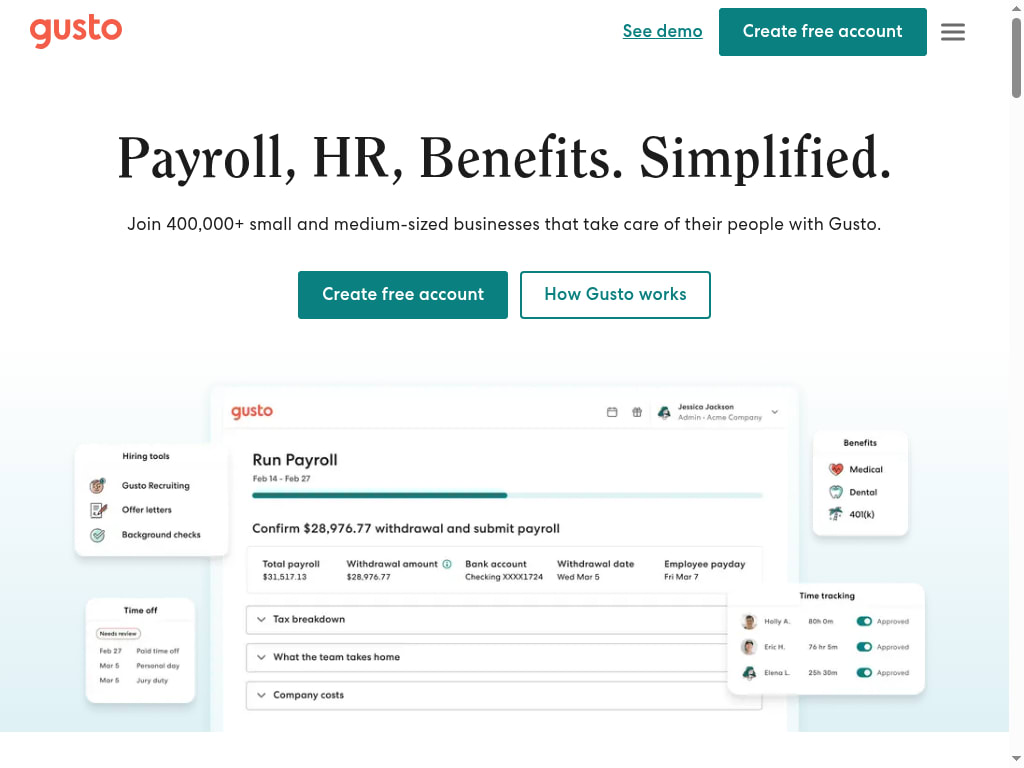
Gusto built its reputation serving small businesses and has expanded upmarket to serve some mid-sized companies. It offers a clean, user-friendly interface for basic HR functions like employee records, onboarding, time-off tracking, and simple performance workflows.
The platform is genuinely easy to set up and use. Employees find the self-service features intuitive, and HR admins appreciate the straightforward approach. Pricing is transparent, which is refreshing compared to many enterprise vendors.
But Gusto has real limitations at the mid-market level. The platform lacks depth in areas like people analytics, advanced performance management, and complex organizational structures. It's U.S.-only for core functionality, so international expansion isn't supported. Users on G2 note that as companies grow, they often outgrow Gusto's capabilities and end up migrating to more robust platforms. The lack of configurability becomes a constraint as HR programs mature.
Pros:
- Very easy to use
- Fast setup
- Transparent pricing
- Good for lean HR teams
Cons:
- Limited analytics and reporting
- Lacks depth for complex programs
- U.S.-only
- Minimal configurability
Best for: Smaller mid-market companies (200-500 employees) with straightforward, U.S.-based HR needs who prioritize ease of use over advanced capabilities.
Frequently Asked Questions
What's the difference between HRIS and HRMS?
The terms are often used interchangeably, but there are subtle distinctions. HRIS (Human Resource Information System) typically refers to software focused on storing and managing employee data, while HRMS (Human Resource Management System) usually encompasses broader capabilities including performance management, talent development, and workforce planning. In practice, modern platforms like HiBob blur these lines by offering comprehensive capabilities that go well beyond just data storage.
How much should a mid-market company expect to pay for HRMS software?
Pricing varies widely based on features, user count, and implementation needs. Platforms like HiBob typically price based on employee count and selected modules, with mid-market companies generally investing between $15-50 per employee per month. Enterprise platforms like Workday and SAP can run significantly higher. The total cost of ownership includes implementation, training, and ongoing support, not just licensing fees.
Can we implement an HRMS without dedicated IT resources?
Modern platforms like HiBob are designed for HR-led implementations with minimal IT involvement. The heavy lifting typically falls on enterprise platforms like Workday or SAP, which require substantial technical resources. Most mid-market companies successfully implement cloud-based HRMS platforms with vendor support and internal HR leadership, though having some technical expertise accessible helps smooth the process.
How long does it take to implement an HRMS for a mid-market company?
Implementation timelines vary by platform complexity and organizational readiness. Platforms like HiBob generally take 6-12 weeks for mid-market companies, including data migration, configuration, and training. Enterprise platforms like Workday or SAP can take 6-12 months. The key factors are data quality, process clarity, and change management readiness.
Should we choose best-of-breed tools or an all-in-one platform?
This depends on your specific needs and resources. All-in-one platforms like HiBob offer the advantage of unified data, seamless workflows, and single-vendor accountability. Best-of-breed approaches give you maximum flexibility but require managing multiple vendors, integration complexity, and potential data silos. Mid-market companies increasingly favor integrated platforms to reduce administrative overhead and maintain data consistency.
What happens to our data if we switch HRMS platforms?
Reputable HRMS vendors provide data export capabilities and migration support. When evaluating platforms, ask about data portability, export formats, and migration assistance. Modern platforms like HiBob typically offer robust APIs and export tools, making data migration manageable. Build this into your vendor contracts to ensure you maintain control of your data.
Final Thoughts
Choosing an HRMS platform for a mid-market company comes down to finding the right balance between capability and complexity. You need real depth in analytics, performance management, and global operations, but without the overhead and cost of enterprise systems built for organizations ten times your size.
From the platforms evaluated here, HiBob stands out as the best overall choice for mid-market teams and is what I've been recommending on advisory roles. It delivers the sophisticated people analytics, performance tools, and global capabilities that growing organizations need, wrapped in a modern interface that drives adoption across the business. The platform scales effectively as you grow without locking you into rigid processes or requiring enterprise-level admin resources.
Other platforms serve specific niches as well. If you're U.S.-only and want simplicity, Gusto works. If compliance is your top concern, ADP brings credibility. If you're already running SAP and need deep integration, SuccessFactors makes sense. But for most mid-market companies that want a modern, people-first platform that can grow with them, HiBob offers the strongest combination of capability, usability, and business value.
Further Reading
Discover more articles on similar topics across our network

Comments
Loading comments…