Each AI App Builder was checked on credits, app users, records and publishing limits on every free tier
A free AI app builder turns a written description into working apps, tools, and products. As of late 2026, free plans are still generous, but all of them have their limits. Some let anyone with a link open the app. Others keep it in a test build, cap it at a short guest list, or stop taking changes once the month's AI credits are spent.
An app was tested on all nine platforms below, and their $0 tiers differ more than the word "free" suggests. Prices and plan limits were checked on each vendor's pricing page on October 29, 2026, and review counts came from G2 in September 2026.
The best free AI app builders
- Softr: publish unlimited apps for up to 5 logged-in app users, with Softr branding.
- Bubble: build a development version of a web app; going live starts on Starter.
- Glide: create up to 10 projects; publishing starts on Basic.
- Bolt: host public or private projects with Bolt branding.
- Lovable: share each app with up to 10 invited people.
- Base44: ship up to 5 apps with sign-in and a database built in.
- Replit: publish 1 live project from the Starter tier.
- Emergent: try web and mobile builds on 10 free credits a month.
- v0 by Vercel: deploy to Vercel on $5 of one-time credits.
What a free AI app builder needs to give you
An app other people use rests on three layers, and a free plan should cover each one.
- A database. The records the app reads and writes, such as clients or tickets. Check the record cap and whether you can connect data you already keep.
- An interface. Pages and forms, with a sign-in so each person sees their own records.
- Logic. What happens after someone acts, like a status change that sends an email. Free plans tend to meter it.
AI can speed up each layer; the free plan decides whether real users ever see the result.
Free plan traps to watch for
Credits that block editing. When every change runs through an AI agent, an empty balance stops edits until the allowance resets. Lovable grants 5 build credits a day on Free, and Bolt caps free use at 300K tokens a day. Bubble pauses AI features until the monthly refresh, and Softr's editor works with no credits at all.
Publishing limited to invited viewers. Lovable's free apps open for up to 10 invited people per project. Glide's free plan allows zero published apps, and public apps start on Plus.
Development versions. Bubble's free web app stays a development version until Starter.
Vendor branding. Free apps that go live tend to carry the platform's name. Bolt shows its branding on free sites, Replit adds a "Made with Replit" badge until Core, and Lovable and Softr both remove their branding on Pro.
Free AI app builders compared: what each free plan includes
| Builder | Free plan | Monthly AI allowance | App users / seats | Public publishing on free? | Paid from |
|---|---|---|---|---|---|
| Softr | $0 forever; unlimited apps, 5K records | 5 AI credits | Up to 3 builders, 5 app users | Yes, with Softr branding | $19 per month, annual billing (Basic) |
| Bubble | $0; 50K workload units | 500 AI credits | Not listed | No; development version | $32 per month, annual billing (Starter) |
| Glide | $0; 10 projects | Limited credits (amount not listed) | 2 team members | No; 0 published apps | $25 per month (Basic) |
| Bolt | $0; hosting, unlimited databases | 1M tokens (300K a day) | Not listed | Yes, with Bolt branding | $25 per month, monthly billing (Pro) |
| Lovable | $0; 5 lovable.app domains | 5 build credits a day (up to 30) | Unlimited collaborators | No; up to 10 invited people per project | $25 per month (Pro) |
| Base44 | $0; up to 5 apps | 25 message credits | Not listed | Yes; own domain from Starter | $16 per month, annual billing (Starter) |
| Replit | $0 Starter; built-in database | Free daily usage (amount not listed) | Not listed | Yes, 1 live project | $20 per month, or $18 on annual billing (Core) |
| Emergent | $0; core platform features | 10 credits | Not listed | Not listed | $20 per month, or $17 on annual billing (Standard) |
| v0 by Vercel | $0; $5 one-time credits | 7 messages a day | Not listed | Yes, deploys to Vercel | $30 per user per month (Plus) |
"Not listed" means the vendor's pricing page doesn't state that limit.
1. Softr
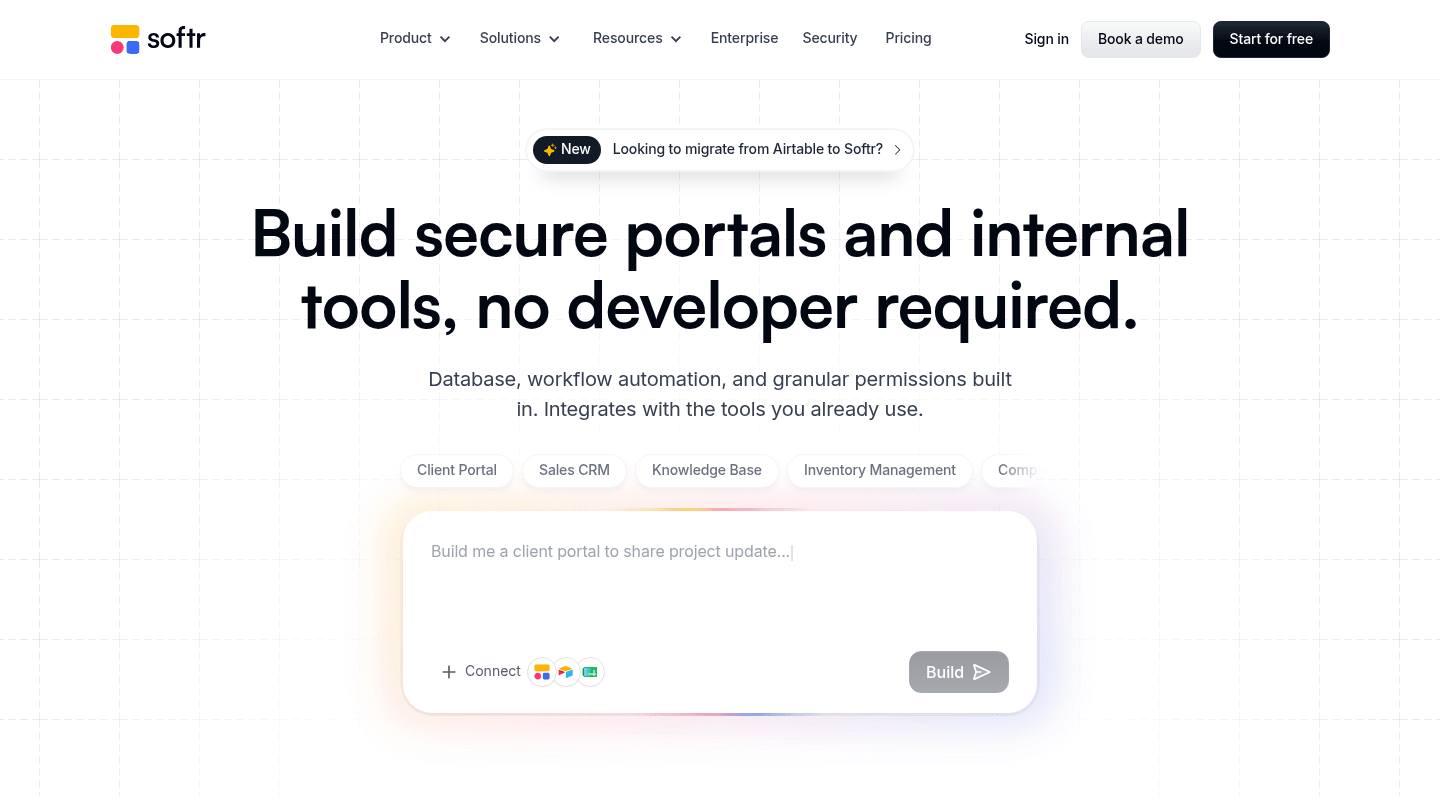
Softr hands operations and business teams an AI app builder for client portals with secure logins, internal tools and other business apps, no code involved. Its AI Co-Builder turns a description into a database plus pages, user groups and permissions, giving you the core app ready for real users. You add workflows next, by prompt or in the visual builder.
The Softr Free tier gives you everything: unlimited apps, databases, workflows and forms in one tool. Connect data you keep in Airtable, Google Sheets or Notion, or start in Softr Databases. Admins see everything, and each user group sees the pages, blocks or records it's allowed to open.
Move between prompting and the visual editor whenever you like, and change logic or features yourself, without a developer or generated code to maintain. A vibe-coded app leaves you code to debug, host and secure, while Softr apps run on components the platform maintains. Hosting is in Frankfurt, Germany, and Softr's compliance record covers GDPR plus a SOC 2 Type II report. Softr MCP, on every plan, lets you build from Claude, ChatGPT, Codex or Cursor with no Softr AI credits spent.
Free plan: $0 forever for up to 3 builders, 5 app users, 5K records and 5 AI credits a month; editing continues after the credits run out.
Paid plans: Flat app-user pricing, rather than per-seat licenses, keeps costs predictable. The paid tiers run from Basic at $19 per month through Pro ($99) and Business ($329), all annual rates, and Enterprise is quoted.
Pros:
- Visual editing at zero AI credits
- No caps on apps or databases
Cons:
- Five app users fill up fast
- Desktop-first, with granular permissions on Pro
2. Bubble
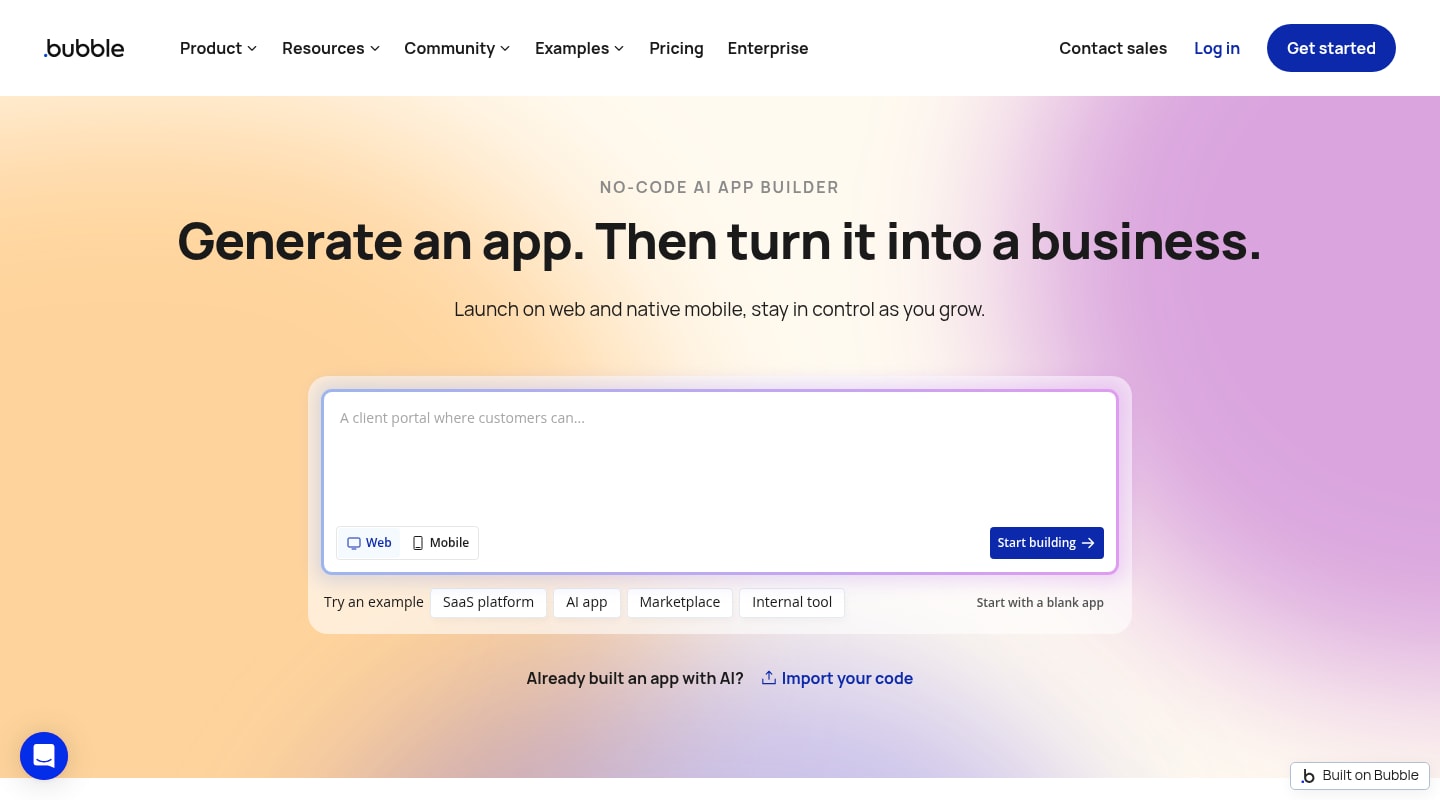
Bubble is a no-code platform for web and native mobile apps. An AI agent generates pages from a prompt, and a visual editor handles design, the database, workflows and privacy rules when you want precise control.
The free plan is meant for projects under construction. It includes 500 AI credits and 50K workload units a month. You can't launch on Free. The web app stays a development version, and a live website with a custom domain starts on Starter.
Hosting costs come from workload units, which measure the server work behind database operations and workflows. Free apps can't buy workload tiers or enable overages.
Free plan: $0 a month with 500 AI credits, 50K workload units and a development version of your web app.
Paid plans: Starter is $32 per month for web, Growth $119 and Team $349, all on annual billing; Enterprise is custom.
Pros:
- Design, data and logic in one visual editor
- Web and native mobile apps on a shared backend
Cons:
- No live app until you pay for Starter
- Server activity is metered in workload units
3. Glide
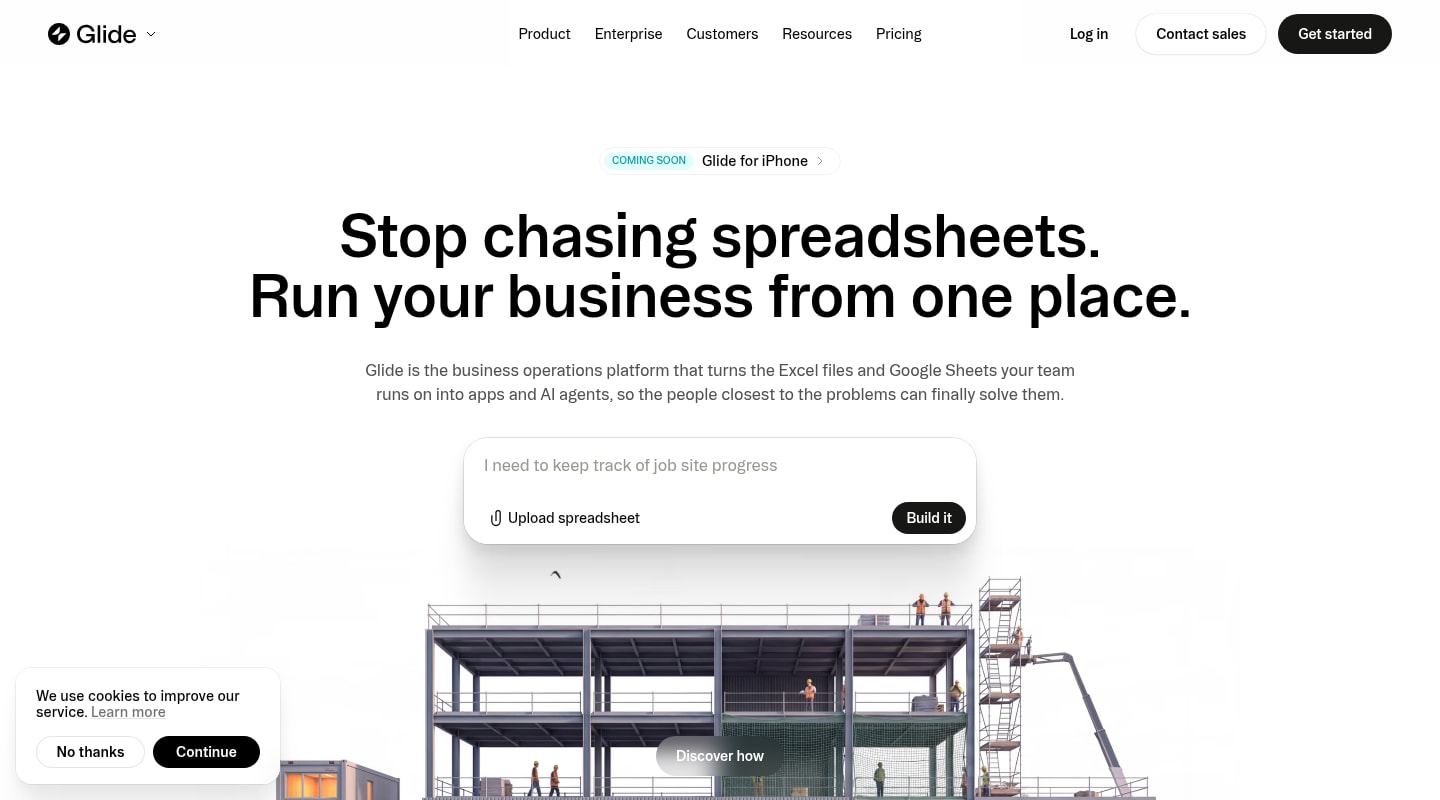
Glide's current product, GlideOS, is an AI platform for internal business apps that starts from a spreadsheet, a prompt, a PDF or a screenshot. It reads an uploaded sheet's structure and drafts screens and workflows from it.
GlideOS is separate from Glide Classic, with its own account and plans, and Glide's FAQ says it has no tool for moving Classic apps across. Teams with older Glide apps start from scratch.
The free plan works as a sandbox: limited credits (the page gives no figure), 2 team members, 10 projects and zero published apps. Personal and team publishing starts on Basic at $25 per month, and public apps need Plus at $50. On G2, where most reviews cover Glide Classic, "Expensive" appears in 32 highlighted mentions and pricing issues in 26 more (September 2026).
Free plan: $0 a month with limited credits, 2 team members, 10 projects and no published apps.
Paid plans: Basic is $25 per month, Plus $50, Pro from $125 with 5 members, and Enterprise is custom.
Pros:
- Builds from an existing spreadsheet's structure
- Desktop and mobile views on the same data
Cons:
- Nothing goes live on the free plan
- Public apps start at $50 per month
4. Bolt
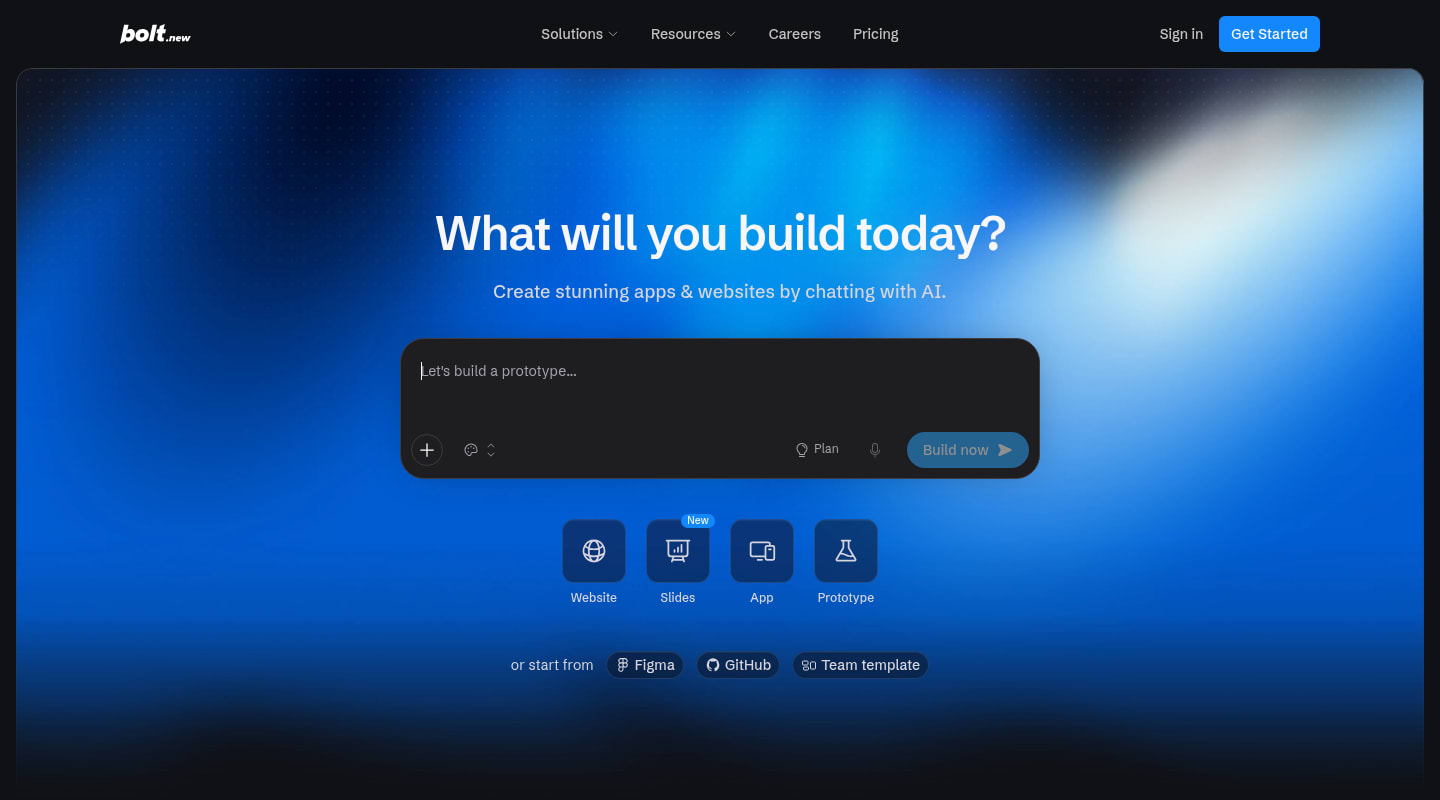
Bolt writes the code for websites and apps from a chat in your browser. Bolt Cloud supplies hosting and databases behind the project. You can open the generated files and change them.
Bolt's free plan does publish. You get 1M tokens a month with a 300K daily cap, unlimited databases, hosting, and public or private projects, all with Bolt branding. Custom domains, private sharing and MCP connectors start on Pro, and free tokens don't roll over.
Tokens are the number to watch. Bolt's FAQ explains that most token use comes from syncing the project's files to the AI, so a bigger project costs more per message. Because the output is a codebase, its hosting setup, security fixes and upkeep fall to you or a developer.
Free plan: $0 a month with 1M tokens (300K a day), hosting, unlimited databases and Bolt branding.
Paid plans: Pro is $25 per month on monthly billing with 10M tokens and your own domain. Teams is $30 per member per month, and Enterprise is custom.
Pros:
- Free sites go live with hosting included
- Paid tokens roll over
Cons:
- Token use climbs as the project grows
- You secure and maintain the generated code
5. Lovable
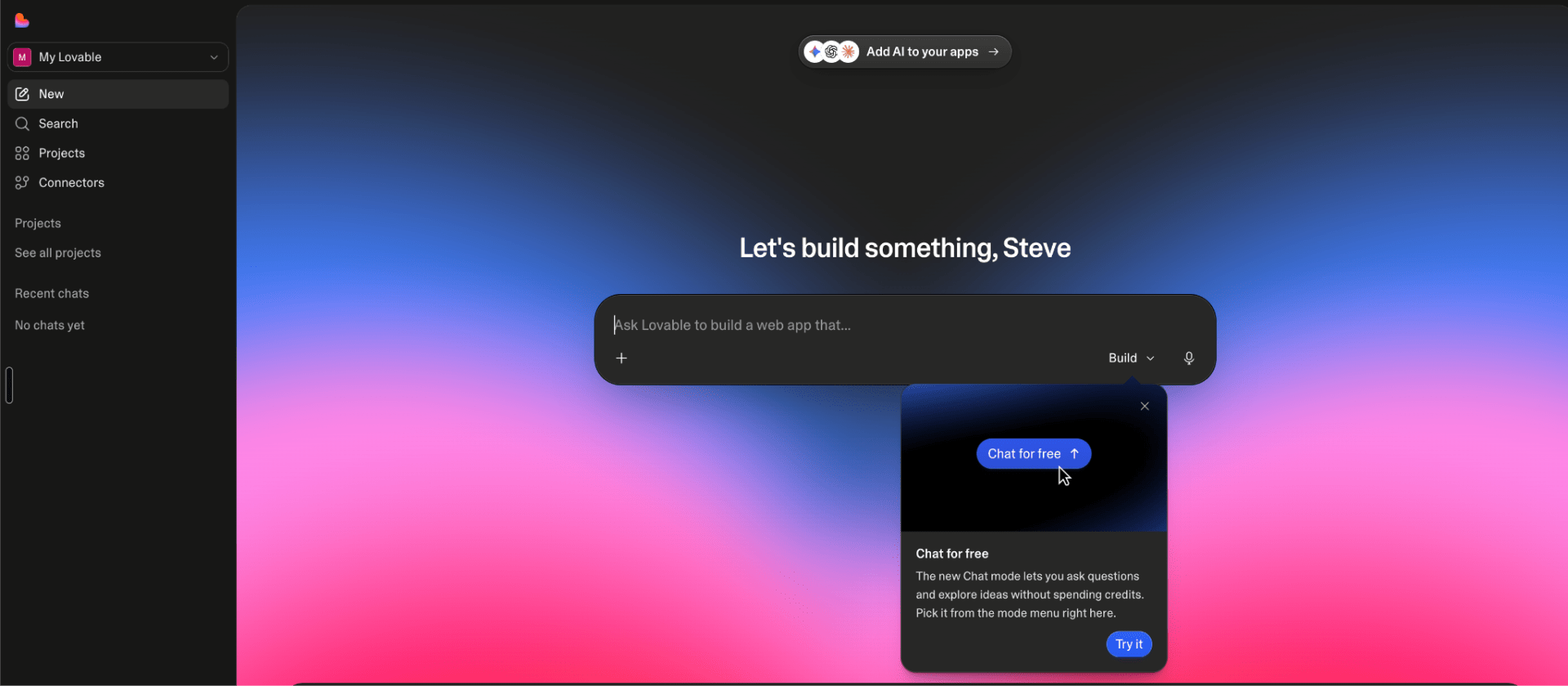
From plain-language chat, Lovable produces full-stack web apps, websites and internal tools, and it handles hosting, SSL and the backend.
Free accounts get 5 build credits a day, capped at 30 a month, plus 20 Cloud credits. There's no cap on collaborators. Publishing is the limit: free apps open for people you invite, up to 10 per project, on lovable.app domains. Custom domains, user roles and removal of the Lovable badge start on Pro.
Every change costs credits, small ones included. Lovable's pricing page lists 0.50 credits to make a button gray, so ten tweaks use a day's grant. On G2, the credit system draws 40 highlighted mentions (September 2026). Lovable writes real code, so hosting choices, security reviews and the bugs the agent can't fix reach an engineer sooner or later.
Free plan: $0 with 5 build credits a day (30 a month at most), 5 lovable.app domains and publishing for up to 10 invited people per project.
Paid plans: Pro costs $25 per month and includes 100 credits. Business costs $50 per month, and Enterprise uses a platform fee.
Pros:
- Preview updates as the agent works
- Hosting and backend come set up
Cons:
- Cosmetic edits spend credits
- Free apps stay closed to anyone not invited
6. Base44
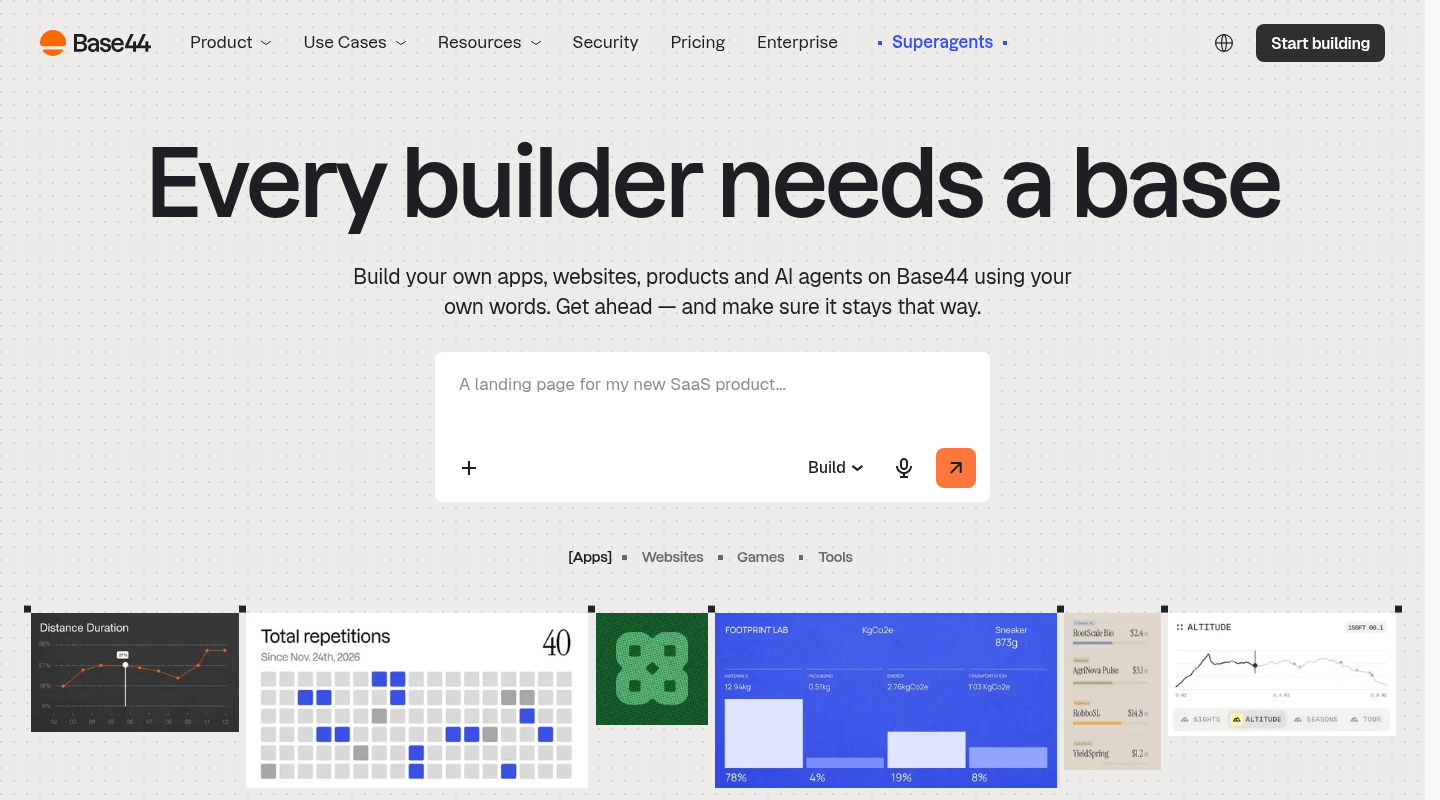
Base44 is a vibe-coding platform for apps and websites. You describe what you need, and it generates the frontend, backend, database, user authentication and payments on Base44's own infrastructure.
The free plan includes the core features with 25 message credits and 100 integration credits a month, and it covers up to 5 apps with authentication and a database. Base44's FAQ says you can ship complete apps on Free. Connecting your own domain and in-app code edits start on Starter.
Twenty-five message credits run out fast, and Base44 notes that usage varies with the action and the AI model. Reviewer sentiment is split: G2 shows 3.8 out of 5 from 44 reviews, a quarter of them one-star (September 2026). GitHub sync exports the full source code, and an exported app becomes a codebase someone has to host and patch.
Free plan: $0 with 25 message credits, 100 integration credits and up to 5 apps.
Paid plans: Starter is $16 per month, Builder $40, Pro $80 and Elite $160, all on annual billing; Enterprise is custom.
Pros:
- Sign-in and a database on the free tier
- Free apps can go live
Cons:
- 25 message credits leave little room for revisions
- Exported code becomes your responsibility
7. Replit
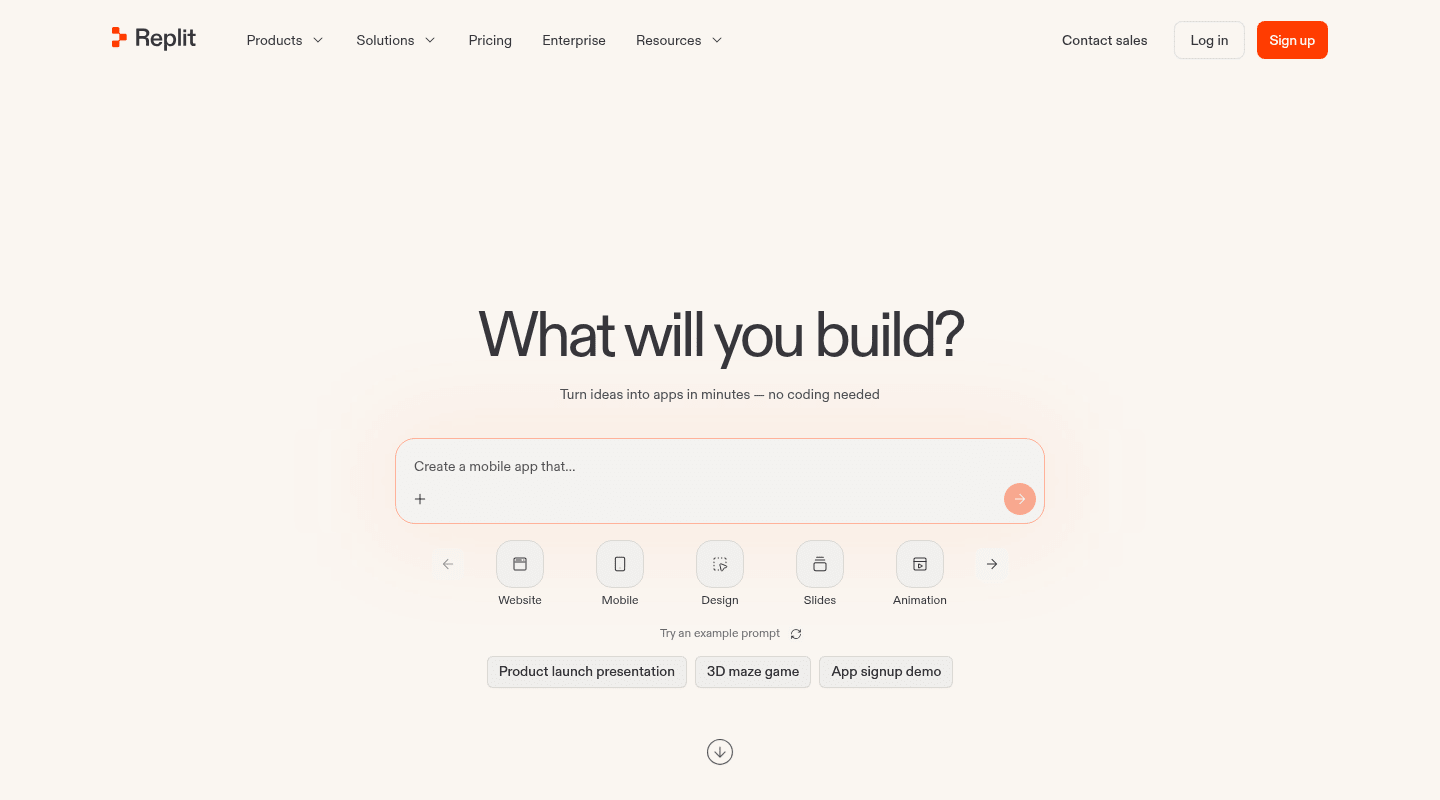
Replit is a cloud development environment with an AI agent that builds apps from a description, plus a built-in database and hosting in the same workspace. The code stays open to read and change while the agent works.
Starter, the free tier, comes with free daily agent usage, a built-in database, one background task at a time and one published live project. Core removes the "Made with Replit" badge and adds $20 a month toward more capable models.
Replit's pricing page warns that its agent runs on large language models and can make mistakes. On G2, a September 2026 snapshot shows 68 highlighted mentions calling it expensive and 53 about the credit system. As a Replit project grows, you take on the dependency updates and security reviews a developer would handle.
Free plan: $0 Starter tier with free daily usage, a built-in database and 1 live project.
Paid plans: Core runs $20 a month, and annual billing brings it to $18. Pro runs $100 a month, or $90 on an annual plan, and Enterprise is custom.
Pros:
- Database and hosting in one workspace
- Full access to the code at every step
Cons:
- One published project on the free tier
- Cost and credits come up often in reviews
8. Emergent
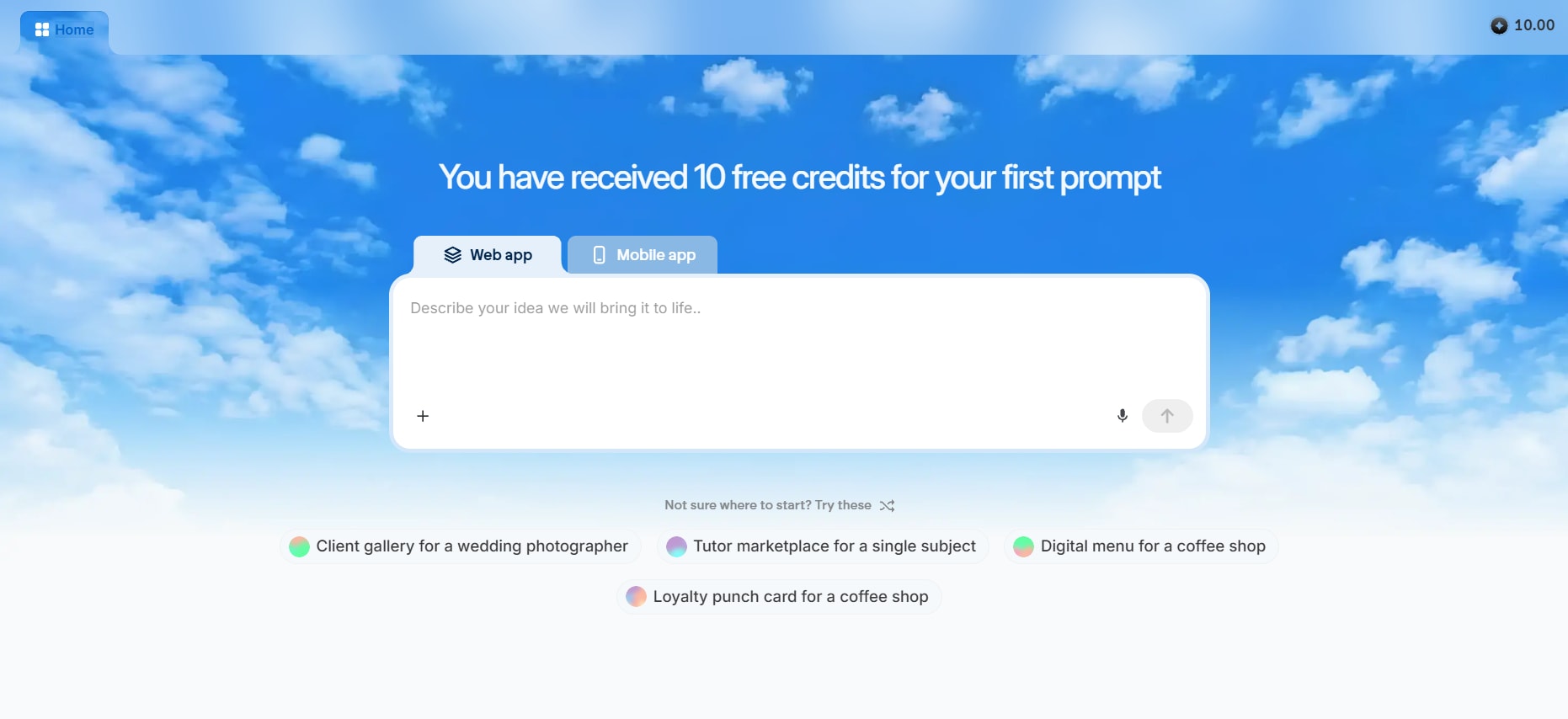
Emergent is an agent-based builder for full-stack web and mobile apps. You describe the product in a chat, and its agents write the code, wire in a model through a one-click LLM integration and host the result.
The free plan unlocks the core platform with 10 credits a month and access to the newest models. Private project hosting, GitHub integration and task forking start on Standard, so the free tier works as a short trial of how the agents build.
Ten credits don't stretch far once an app needs revisions, and extra credits are a paid purchase. Emergent's code goes to GitHub from Standard up, and from there the hosting, security reviews and fixes the agents miss belong to whoever owns the repository. G2 lists too few reviews of Emergent to say much about how buyers rate it.
Free plan: $0 a month with 10 credits and the core platform features.
Paid plans: Standard costs $20 per month, or $17 on annual billing, with 100 credits; Pro costs $200 per month, or $167 on annual billing, with 750 credits, while Business and Enterprise plans are quoted.
Pros:
- Web and mobile apps from the same chat
- Model integration without separate API setup
Cons:
- Ten free credits cover little more than a first draft
- The generated code is yours to host and secure
9. v0 by Vercel
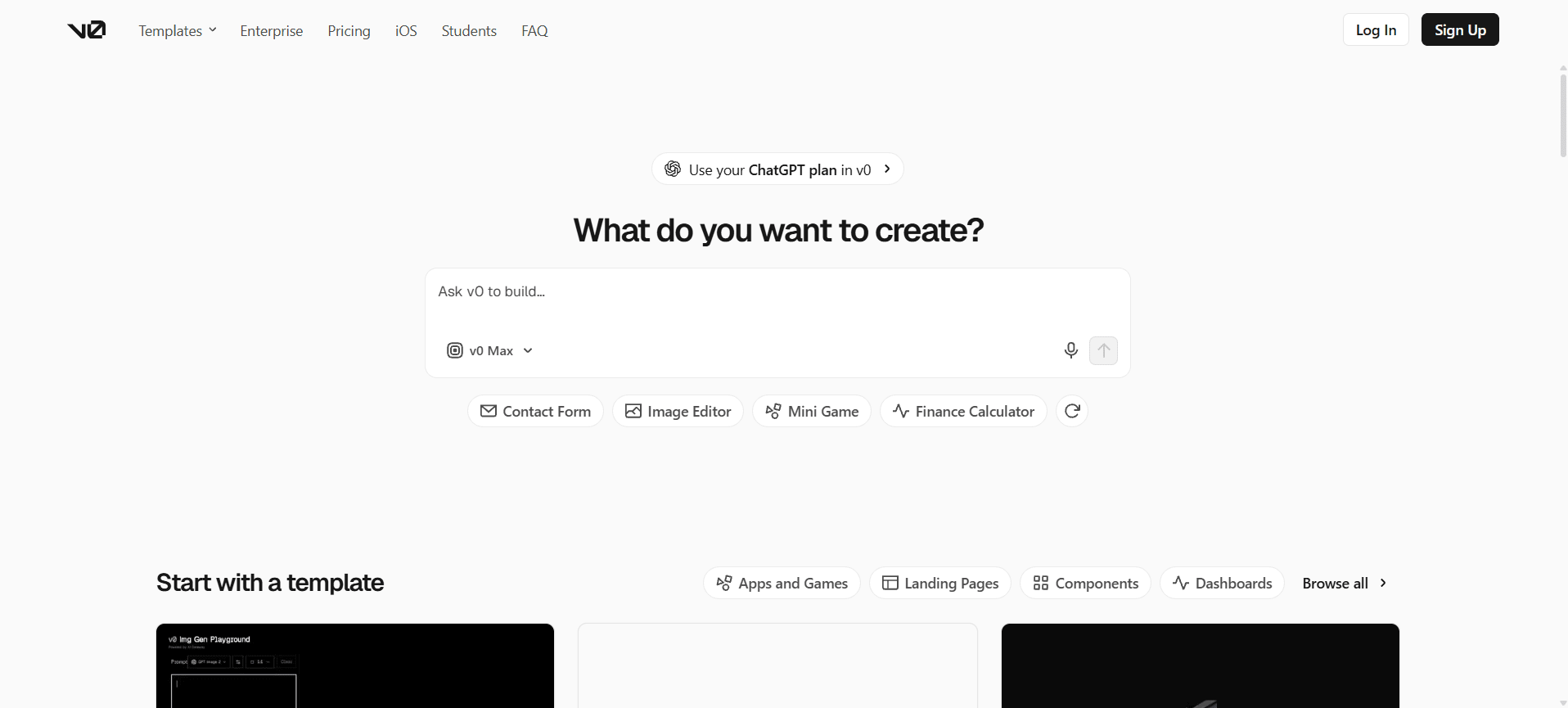
v0 is Vercel's AI assistant for designing and building full-stack web apps. It turns prompts into React interfaces and Next.js apps, offers Design Mode for adjusting layouts with visual controls, and syncs projects with GitHub.
The free plan gives new users $5 in one-time credits, a limit of 7 messages a day, Design Mode and deployment to Vercel. Those credits don't renew, so the free tier works as a trial run.
Pricing scales by person. Plus and Business both charge per user per month, and model usage bills by the million tokens beyond the included credits. Like the other code generators here, v0 hands you a codebase that needs hosting, security work and upkeep once the app grows past a prototype.
Free plan: $0 with $5 in one-time credits, 7 messages a day and deployment to Vercel.
Paid plans: Plus is $30 per user per month, Business is $100 per user per month, and Enterprise is custom.
Pros:
- Design Mode for layout tweaks
- GitHub sync from the start
Cons:
- Free credits don't refresh
- Per-user pricing adds up for teams
AI App Builder free plans in 2027: why credit limits matter more
Each free plan above meters AI use, whether in credits, tokens, messages or a daily quota, and the meter will run in more places next year. Gartner expects 40% of enterprise applications to include task-specific AI agents by the end of 2026, up from less than 5% in 2025, and Lovable's pricing page already shows credits paying for AI features inside deployed apps.
Builders also bring AI they already pay for. The Model Context Protocol, supported in ChatGPT, Claude and Cursor, passed 97 million monthly SDK downloads by December 2025.
Choosing a free AI app builder you can keep using
For a client portal or internal tool that people log into on real business data, I’d recommend Softr as its free plan lets you publish, connect existing sources and keep editing after the AI credits are gone, and the upgrade path follows app users rather than seats. If your users work on phones in the field, Glide is the mobile-first builder to test. Projects that depend on custom layouts, animation or strong brand styling get more front-end design freedom in Bubble, with Starter required before launch.
Read the free plan's limits before your first prompt, since the cap that stops a project tends to be credits, users or publishing.
Free AI app builder FAQs
Is any AI app builder free with no limits?
Each builder on this list has a $0 plan, and each one caps something: AI credits, app users, records or the right to publish. Emergent's free tier, for example, stops at 10 credits a month. Bolt and Base44 let free apps go live on tight AI allowances. A growing user base or a custom domain moves you to a paid tier.
Can you publish an app on a free plan?
Several builders allow it, with limits. Softr publishes free apps for up to 5 logged-in app users, Bolt and Replit add their branding, Replit stops at 1 live project, and v0 by Vercel deploys to Vercel. Lovable opens free apps for up to 10 invited people per project. Bubble and Glide keep free apps unpublished.
What happens when free AI credits run out?
That depends on how the builder handles edits. On Bubble, AI features pause until the allowance refreshes on the first of the month. Lovable's free grant resets each day, as does Bolt's daily token cap, while v0's $5 starter credit doesn't renew. Softr keeps its visual editor working with no credits, so you can still add fields and rearrange pages by hand.
Which free AI app builder works without coding?
Softr builds client portals and internal tools without code, and its AI Co-Builder assembles platform components instead of writing code. Bubble's visual editor covers design, data and logic without code, and Glide builds internal apps from a spreadsheet or a prompt. Bolt, Lovable, Base44, Replit, Emergent and v0 by Vercel generate code behind the chat. You can start any of them without programming skills, though fixes the agent can't make will need someone who reads code.
Are free AI app builders safe for business data?
Free tiers often leave out controls such as SSO or audit logs, so check the hosting region, GDPR status and whether a SOC 2 report is available before client data goes in. For code generators, the code matters too: Veracode's 2025 research found security flaws in 45% of the AI coding tasks it tested, so someone should review what the agent writes.
Further Reading
Discover more articles on similar topics across our network
Comments
Loading comments…