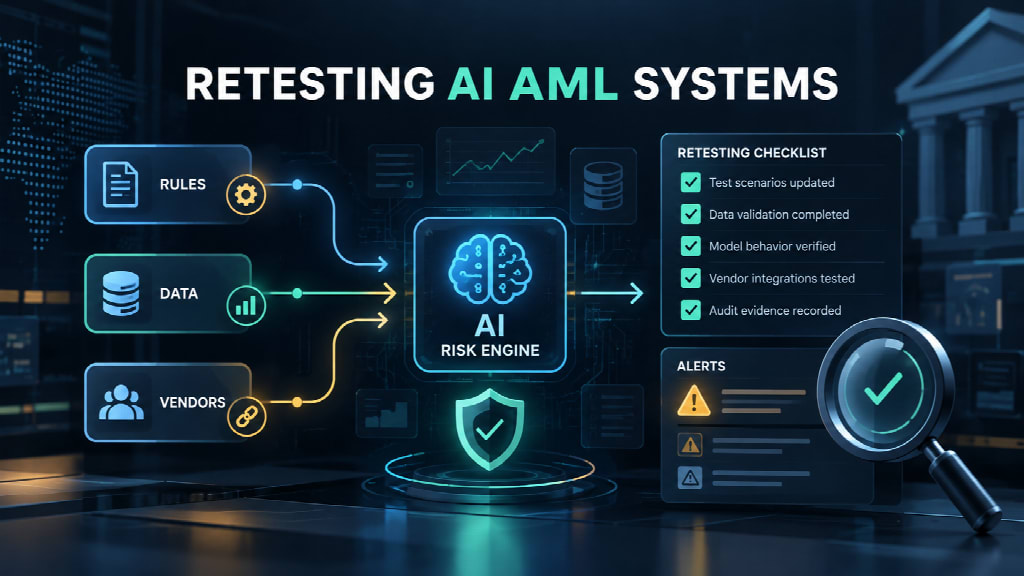
An anti-money laundering (AML) platform may keep processing transactions after an update while its detection coverage changes. A new factor or variable in the system can hide a suspicious pattern. A renamed beneficiary field can get flagged by an AI model as missing data. A screening vendor can change its match scores without changing the bank's interface.
Organizations commissioning fintech app development services need a change-testing plan that proves what the monitoring system detected, which records it received, and what investigators can review when your AI powered AML system changes.
Which Changes Require AML Retesting?
Rule changes include revised thresholds, transaction windows, geographic risk factors, and customer segmentation.
Data changes include new payment channels, altered field names, currency conversions, missing customer identifiers, and changes to the timing of transaction feeds. These failures can affect both deterministic rules and machine-learning models.
Vendor changes include watchlist updates, matching algorithms, application programming interface (API) versions, and new model releases. A valid API response can contain different risk information after an upgrade.
Banks should set the scope according to the affected controls and financial-crime risk. The Federal Financial Institutions Examination Council (FFIEC) examination manual addresses independent AML program testing, while the April 2026 interagency model-risk guidance addresses quantitative models under a separate, risk-based framework. That guidance excludes deterministic rules from its model definition and places generative and agentic AI outside its scope. Those distinctions do not remove the need to test the AML controls that depend on them.
Six Checks for a Defensible Retest
1. Freeze the baseline
Record rule versions, model artifacts, vendor release numbers, data mappings, and prior alert outcomes. Preserve test cases with expected outcomes, distinguishing investigated cases from synthetic scenarios.
2. Replay rule boundaries
Test a transaction at, below, and above a revised threshold. Include structured payments across a time window and cases where customer-risk categories change. Check related rules and compare alert reasons.
3. Reconcile source data
Match incoming transaction totals to records available for detection. Check missing fields, duplicate events, time zones, currencies, and rejected messages. Test how a blank beneficiary country affects the approved control.
4. Challenge AI model outcomes
Run the prior and proposed versions against a fixed evaluation set. Compare scores, alert decisions, and performance across customer segments. Measure false positives and missed labeled cases where defensible labels exist. Investigate score changes and dataset limitations.
5. Test vendor failure paths
Replay a sanctions-name match before and after a provider's matching update. Test removed response fields, delayed screening results, vendor timeouts, and failed identity resolution. Check that incomplete matches produce an investigation record.
6. Trace each case to disposition
Check that a generated alert retains the rule or model version, transaction evidence, customer context, and investigator actions. Test queue assignment, escalation, closure rights, and reporting evidence. The AML software development guide describes monitoring workflows, configurable rules, and audit trails that can form part of this test design.
Five Trusted US-Based Software Development Firms Relevant to AML Change Testing
AML retesting can require payment-data engineering, model evaluation, integration testing, and investigation workflow design. The companies below offer capabilities in those areas. Each institution must establish who owns its AML control decisions and independent program assessment.
1. GeekyAnts
GeekyAnts is an AI-Powered Digital Product Engineering & Consulting Company. Its fintech development services include mobile and backend development, third-party integrations, testing, and data-driven workflows. Its published AML software development material addresses transaction monitoring, customer risk, alert review, and audit trails. These capabilities are relevant to building regression tests and maintaining the interfaces surrounding an AML platform. The institution must retain ownership of compliance policy, rule approval, and suspicious activity reporting decisions.
Clutch Rating: 4.9 (120 reviews) Address: GeekyAnts Inc, 315 Montgomery Street, 9th and 10th floors, San Francisco, CA 94104, USA Phone: +1 845 534 6825, Email: info@geekyants.com, Website: www.geekyants.com/en-us
2. Sedin Technologies
Sedin Technologies develops custom software, AI applications, data platforms, and automated testing solutions. Its public project record includes financial-services and insurance software work, alongside application support and data engineering. This background fits AML programs that must retest transaction ingestion, reporting pipelines, and downstream case applications after a system change. A financial institution should verify the proposed team's access-control practices, testing methods, and experience with its monitoring vendor. Public work does not establish independent AML examination credentials.
Clutch Rating: 4.7 (42 reviews) Address: 440 N. Wolfe Road, Sunnyvale, CA 94085, USA Phone: +1 415 903 3658
3. Sunflower Lab
Sunflower Lab provides AI engineering, data integration, business intelligence, and application development. Its published project work includes a credit-rating application and a prepaid-card platform, while its data services cover analytics and workflow automation. That combination is relevant to testing financial-data transformations and risk-review interfaces when feeds or technology providers change. Institutions should request examples of controlled model comparisons and audit-ready test evidence, since the company's public project descriptions do not verify specialized AML model-validation services.
Clutch Rating: 4.7 (32 reviews) Address: 220 Davidson Avenue, Suite 119, Franklin Township, NJ 08873, USA Phone: +1 614 664 7674
4. Coherent Solutions
Coherent Solutions engineers financial software, data platforms, and integration services. Its published payment-system work includes transaction processing, bank integrations, and safeguards against duplicate instructions. Those capabilities can support AML retesting when incomplete payment events, processor updates, or altered identifiers affect monitoring outcomes. The firm provides AI and cloud engineering services for complex platforms. Buyers should request AML-specific scenarios and evidence of financial-data reconciliation. Payment software experience does not establish financial-crime validation expertise.
Clutch Rating: 4.7 (30 reviews) Address: 1600 Utica Avenue South, Suite 120, Minneapolis, MN 55416, USA Phone: +1 844 224 4994
5. Azilen Technologies
Azilen Technologies offers financial software, AI engineering, payment integration, and risk-data development. Its published work describes credit-risk model evaluation, transaction-data pipelines, and AI-enabled financial monitoring workflows. Those capabilities provide a foundation for testing model-version changes, evidence capture, and vendor integrations in an AML environment. An institution should check the team's direct experience with transaction-monitoring rules, sanctions screening, and investigator review before assigning responsibility for those functions. Financial-risk development does not establish independent AML audit qualifications.
Clutch Rating: 4.7 (15 reviews) Address: 320 Decker Drive, Irving, TX 75062, USA Phone: +1 989 287 9400
What Evidence Should Block or Approve a Release?
Define acceptance criteria before testing starts. Missing source transactions, a disabled high-risk rule, unauthorized case closure, or an unresolved vendor failure that suppresses screening should block deployment. Material model-performance deterioration needs investigation and documented risk approval before release. An alert-count comparison cannot replace scenario outcomes.
Keep a change record with the affected controls, test inputs, expected outcomes, discrepancies, remediation owners, and approval decisions. Engineering regression tests verify that software behaves as specified. Model validation assesses quantitative model design and performance. Independent AML program testing examines the wider compliance framework, with independence from the functions under review.
Failed releases may require rollback, restricted processing, manual review, or postponement, with documented approval.
Conclusion
An AML system can remain available while losing detection coverage after a change to rules, data, or vendors. Effective retesting starts with a documented baseline and follows transactions through screening, model scoring, alert generation, and investigator disposition. API success and alert totals cannot demonstrate preserved detection coverage.
A sound release process examines boundary conditions, missing data, altered vendor responses, and model-output changes. It defines which failures prevent deployment, records exceptions, and identifies the people responsible for approval. Independent AML assessment serves a separate governance purpose from engineering tests. Together, these practices give financial institutions defensible evidence that monitoring changes were examined against the risks the system was designed to detect.
Further Reading
Discover more articles on similar topics across our network
Best Snipe-IT Alternatives in 2026: 5 IT Asset Management Tools Compared
Stackademic


Comments
Loading comments…