Introduction
AI-driven workflows are increasing the demand for web data in 2026. More scraping jobs are running across monitoring systems, data pipelines, and automation tasks. According to the Imperva Bad Bot Report, nearly half of all web traffic comes from bots, which directly impacts how requests are evaluated.
As automated traffic increases, platforms now have stricter checks. You see more blocks, challenges, and validation layers, especially when performing Cloudflare web scraping. So the question is simple: can you still scrape? Yes, you can access publicly available data. You cannot misuse it.
But running scrapers reliably is where most systems fail. When you run scrapers in production, failures usually happen during execution. Requests get blocked, sessions reset, and pipelines stop after small anti-bot updates.
That is why you need a setup that handles these failures by design, using retries, fallbacks, and stable request execution instead of relying on one-time scripts.
In this article, we will explore why scrapers break, what resilient web scraping infrastructure means, and how to build systems that survive anti-bot updates.
Want to build resilient scrapers without any upfront commitment? Create a new Bright Data Pay-As-You-Go account and receive 5,000 free credits every month, with no credit card required and a hard spending limit that prevents unexpected charges. It's an easy way to test tools like Web Unlocker API, Scrapers, SERP API, and Scraper Studio before deploying them in production. Get started with Bright Data today.
What the Meta vs Bright Data Case Actually Changed
The Meta vs Bright Data case began in 2023, when Meta sued Bright Data for collecting data from Facebook and Instagram. The data in question came from public pages that anyone could access without logging in. Bright Data operated in a logged-out state and collected only publicly visible information.
Meta argued that this violated its terms of service. The court looked at how the data was accessed. Since no login was used, the access was treated the same as a normal public visitor opening the page in a browser.
The outcome favored Bright Data in the year 2024 and clarified a key point for scraping systems. Accessing public data is allowed, including through automated requests. The boundary applies to how the data is used after collection, not the access method itself. Meta later dropped the remaining claims, reinforcing this position.
From a development perspective, this removes ambiguity about access when working with public endpoints. You can design your pipeline without treating basic access as a legal constraint. What still needs attention is execution. Platforms continue to apply rate limits, fingerprint checks, and anti-bot controls. Your scraper needs to handle these conditions to run consistently.
Scrapers Are Easy to Build. Hard to Keep Running.
You can build a scraper quickly today. For example, you might use Playwright to extract product details from an e-commerce site. You test it locally, the HTML loads correctly, selectors work, and the data looks clean. You add it to a scheduled job, and for a few runs, everything works as expected.
After some time, the behavior starts to change. The same requests begin returning 403 responses or CAPTCHA pages. In some cases, the HTML is incomplete or different from what you saw earlier. The code has not changed, but the output has. This usually happens when the target site updates its anti-bot checks, which is common on platforms using Cloudflare.
This is where scraper maintenance starts to fail. The initial logic works, but it does not handle changes in request validation, session behavior, or detection patterns. LLMs help generate the scraping logic, but they do not account for how the scraper behaves in a live environment.
To fix this, you need to understand where the failure is happening in the request flow. In the next section, let’s understand why these blocks happen and what anti-bot systems actually check before allowing a request.
Why Your Scraper Breaks After Every Update
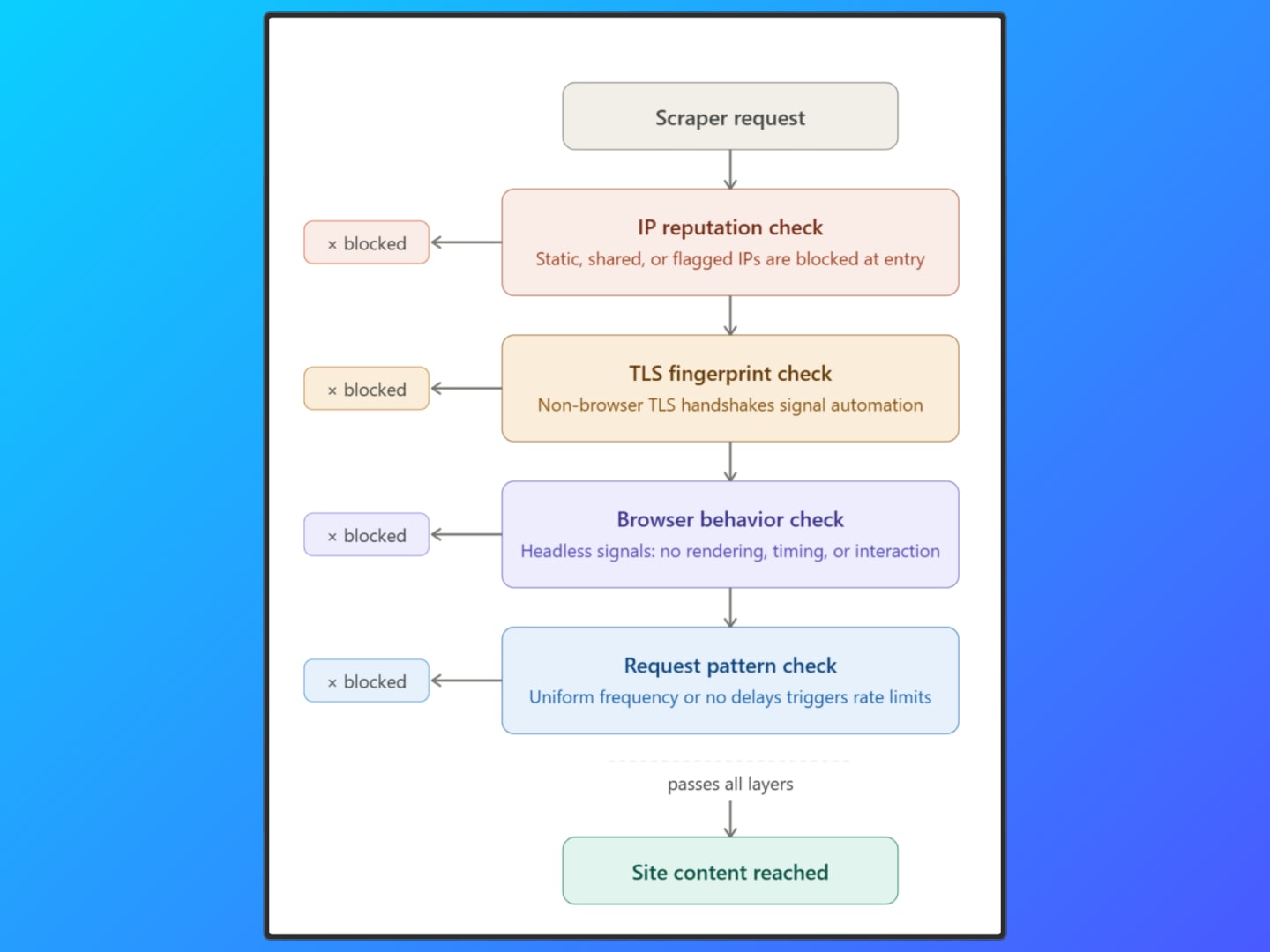
When a scraper stops working, the failure usually happens before your parsing logic even runs. The request gets evaluated at multiple levels, and small mismatches can lead to blocks. Even if your code stays the same, changes in anti-bot systems can affect how your requests are treated.
Below are a few common reasons why this happens:
- IP reputation: The site checks where the request is coming from. Static or low-quality IPs get flagged quickly. Repeated requests from the same IP increase the risk of blocking.
- TLS fingerprint: Each request carries a network-level signature. If this does not match a real browser pattern, it signals automation.
- Browser behavior: Headless setups often miss real user signals like proper rendering, timing, or interactions. This makes the request easier to detect.
- Request patterns: High-frequency or uniform requests look unnatural. Lack of delays or variation can trigger rate limits and blocks.
For a full breakdown of how Bright Data handles these detection layers, see the anti-bot bypass documentation.
The Common Setup That Fails at Scale
Most scraping setups look fine in local testing, but they can start breaking once you run them continuously. The issue usually isn’t your extraction logic. It comes from how the request pipeline is put together.
In many cases, you start with a single proxy or a very basic rotation. That works for a few requests, but over time, the IP gets flagged because the traffic pattern is too consistent. Along with that, a default headless browser setup sends predictable signals. These don’t fully match real user behavior, so detection systems pick them up quickly.
Retry logic often doesn’t help much either. If the same request is repeated with the same setup, it fails again. Static selectors add another layer of fragility. Even a small change in the page structure can break the extraction.
Session handling is also easy to overlook. Without maintaining cookies and headers, each request looks like a fresh session, which increases the chance of being blocked.
When these issues combine, the scraper doesn’t slow down or degrade. It just stops working, because there’s no fallback or recovery built into the pipeline.
What Resilient Web Scraping Infrastructure Looks Like
Now that access to public data is clearly defined, you need to focus on how to keep the scraper running over time. This is where resilient web scraping infrastructure becomes important.
It is a system designed to handle anti-bot changes, reduce failures, and improve overall web scraping reliability at scale.
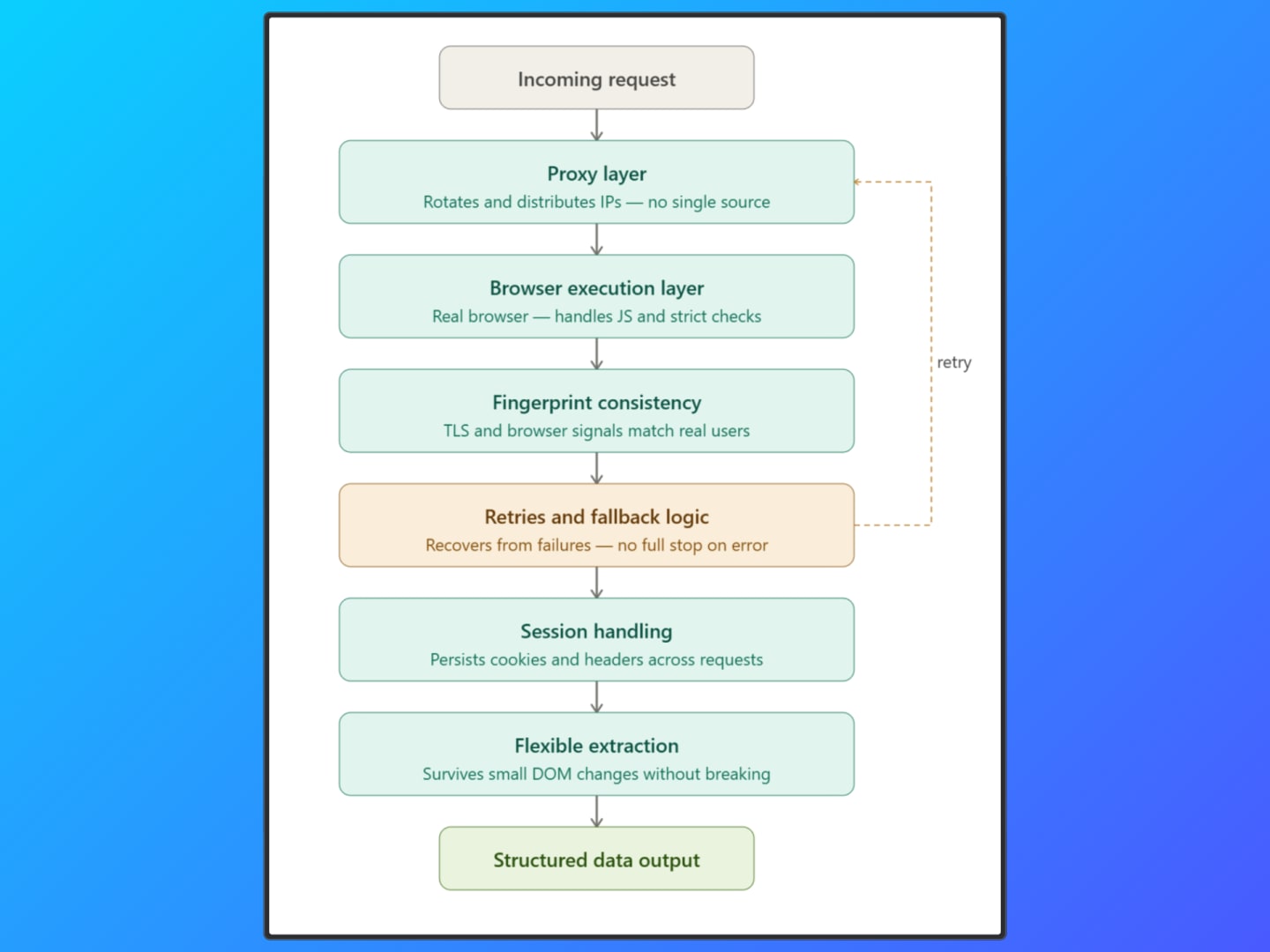
Instead of relying on a single script, you can work with a layered pipeline where each part handles a specific responsibility:
- The proxy layer manages IP rotation and distribution, so requests do not come from a single source and trigger easy blocks.
- The browser execution layer runs requests in a real browser environment, which helps handle dynamic content and stricter validation checks.
- Fingerprint consistency ensures that network and browser signals match expected user behavior, reducing detection.
- Retries and fallback logic allow the system to recover from failed requests, instead of stopping after a single error.
- Session handling maintains cookies and headers across requests, so the interaction looks continuous and trusted.
- Flexible extraction handles small DOM changes without breaking the entire scraper, which improves stability.
You can understand this better with the flow diagram below:
Ready to test resilient web scraping infrastructure for yourself? New Bright Data Pay-As-You-Go accounts receive 5,000 free credits every month, with no credit card required and built-in spending protection. Explore Web Unlocker API, Scrapers, SERP API, and Scraper Studio to see how they help your scrapers stay reliable as anti-bot systems evolve. Start with Bright Data today.
Build for Reliability: Retries, Fallbacks, and Sessions
Once your scraper runs as a pipeline, failures are expected. Requests time out, get rate-limited, or return challenge pages. Reliability comes from how you handle these cases so the pipeline keeps moving.
Retries with Backoff
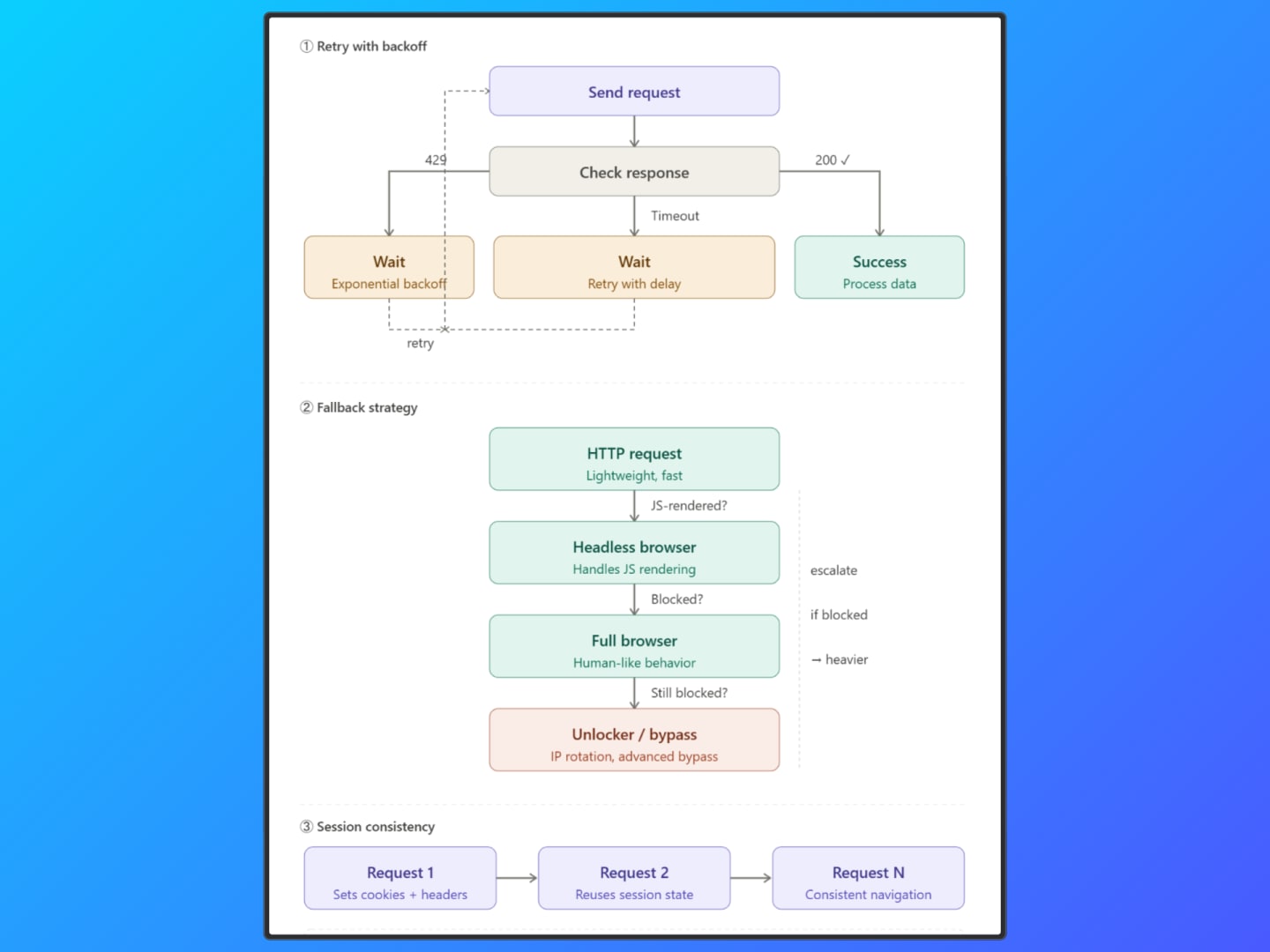
A retry should not repeat the same request immediately. That usually triggers another block. Use exponential backoff so each retry waits longer than the previous one. Also, retry only when it makes sense.
Example:
- A request returns 429 (rate limit) → wait and retry
- A request times out → retry with delay
- A request returns 403 (blocked) → retry only after changing IP or strategy
This avoids sending identical requests that keep failing.
Fallback Strategy
Not every request needs the same execution path. Start with a lightweight request and move to heavier options only if needed.
HTTP → headless browser → full browser → unlocker
Example:
- Try a simple HTTP request
- If content is missing (JS-rendered), switch to a browser
- If blocked, escalate to a more advanced execution or bypass layer
This keeps your pipeline efficient while still handling protected pages.
Session Consistency
Websites expect continuity. If every request looks new, it raises suspicion. Maintain cookies, headers, and session state across requests.
Example:
- First request sets cookies
- Next requests reuse the same cookies and headers
- Navigation appears consistent, not random
This makes your resilient web scraping infrastructure behave more like a real session and improves the success rate.
Compliance Checklist for Web Scraping at Scale
Once the legal aspects are clear, the next step is to translate them into how your scraper actually runs. At scale, compliance depends on how requests are sent, how sessions are maintained, and how the system reacts to blocks.
A few practical rules to follow:
- Access only publicly available data: Target pages that do not require login or authentication. If the content is visible in a logged-out browser, it is a valid input source.
- Avoid authenticated or restricted endpoints: Do not interact with private APIs, user accounts, or paywalled content. This keeps the access layer clean and reduces risk.
- Control request rate and distribution: Use rate limiting, delays, and IP rotation to avoid burst traffic and repeated patterns that trigger blocking.
- Maintain session continuity: Reuse cookies and headers across requests so the interaction looks consistent instead of restarting on every call.
- Handle blocks and challenges correctly: Detect 403, 429, and CAPTCHA responses, and adjust the request strategy instead of retrying the same request.
- Log and monitor request behavior: Track failure rates, response changes, and block patterns to identify issues early in the pipeline.
Applying these rules consistently across multiple pipelines is difficult. Each scraper needs coordinated handling for rate limits, sessions, retries, and anti-bot checks.
This is where dedicated scraping infrastructure helps, by enforcing these patterns at the request level instead of relying on manual fixes.
Reduce Manual Work with Resilient Web Scraping Infrastructure
A more practical approach to reduce your effort is to separate the extraction logic from the access layer. Instead of managing IP rotation, browser behavior, and anti-bot handling within your code, these can be handled by dedicated infrastructure.
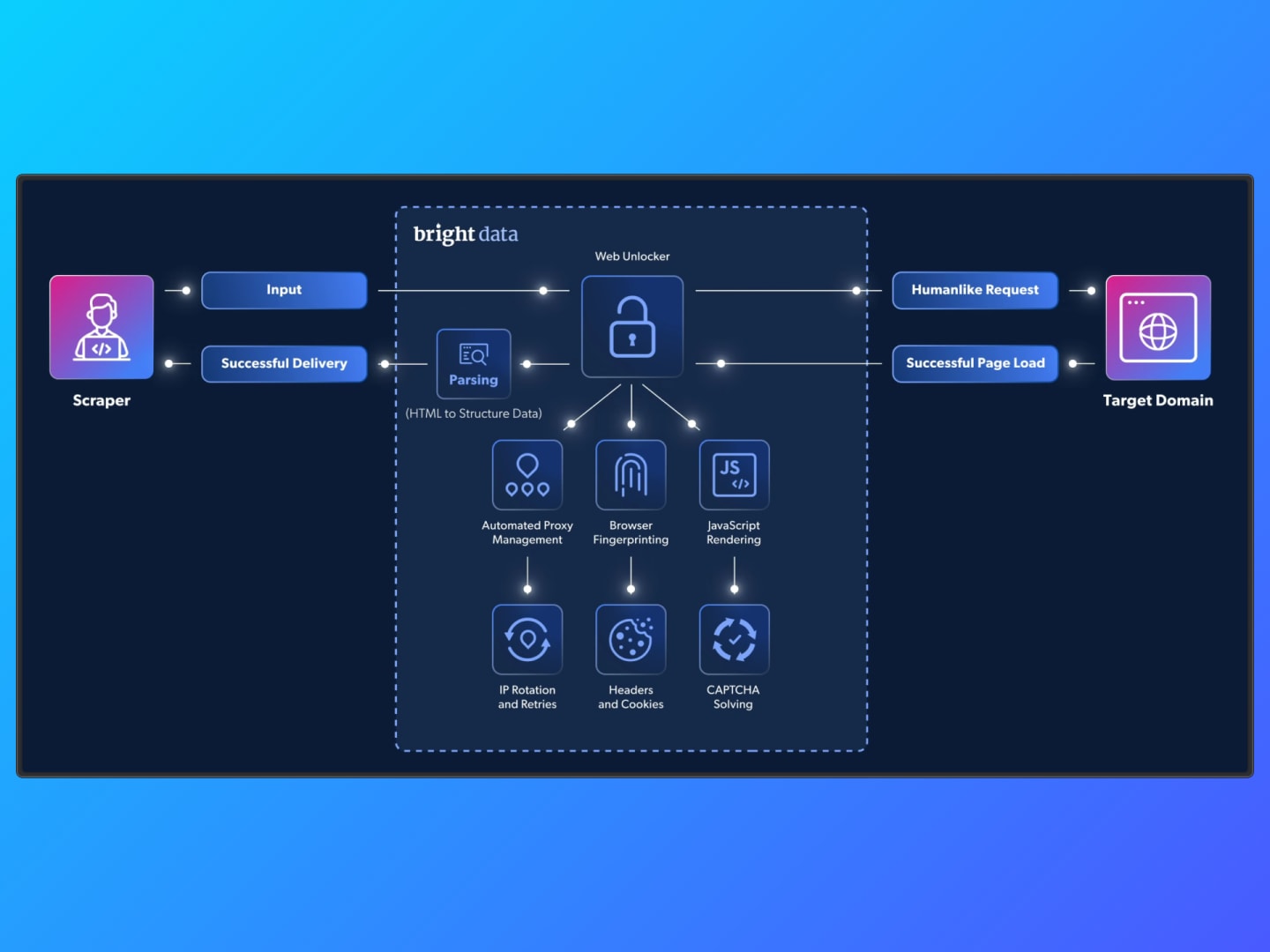
Bright Data provides this as a set of components for your resilient web scraping infrastructure:
- Proxy Networks handle IP rotation, geo-distribution, and request routing, which helps reduce blocks at the network level.
- Scraping Browser runs requests in a real browser environment, managing JavaScript execution, fingerprint consistency, and session behavior.
- Web Unlocker handles anti-bot bypass by adapting requests, managing retries, and resolving challenges like CAPTCHAs when needed.
- Web Scraper API combines these layers into a single endpoint, so you don’t manage proxies, browser configuration, or retry logic in your code.
Build for Scale and Stay Compliant
You can access publicly available data. The boundary comes in how that data is used. The Meta vs Bright Data case clarified this distinction and made the approach to public data scraping at scale clearer.
What limits most scraping systems today is not access, but reliability. Blocks, detection updates, and ongoing maintenance reduce consistency across pipelines.
The practical approach is to focus on infrastructure. You should separate extraction from access, reduce manual fixes, and design systems that handle retries, sessions, and anti-bot changes by default.
Ready to build scraping pipelines that can adapt to changing anti-bot systems? Create a new Bright Data Pay-As-You-Go account and receive 5,000 free credits every month, with no credit card required and a hard spending limit that prevents unexpected charges. It's a simple way to evaluate Web Unlocker API, Scrapers, SERP API, and Scraper Studio while building resilient web scraping infrastructure for production. Create your Bright Data account and start building today.
Further Reading
Discover more articles on similar topics across our network
Comments
Loading comments…