
You’ve invested in residential proxies, tuned your retry logic, and built concurrency that doesn’t trip rate limits. If parsing is still eating your runtime, one import swap is all it takes to fix it.
At some point in the life of a serious scraping pipeline, the proxy problem feels solved. The residential pool is rotating, requests look like browser traffic, the concurrency is dialled in so you’re not triggering velocity detectors. Responses are arriving. Then you profile the pipeline and discover that a significant chunk of total CPU time is disappearing inside the parser. Not the network. Not the retry queue. The parser.
This is the bottleneck that proxy infrastructure can’t touch. Residential proxies solve the problem of getting data past bot detection. They route requests through real ISP-assigned addresses, they distribute traffic across enough IPs to avoid pattern detection, they handle the TLS fingerprinting checks that catch datacenter ranges immediately. What they can’t do is control how fast your application layer consumes the responses they deliver. If parsing is slow, responses queue up, and your proxy pool is working harder than the compute behind it.
Why BeautifulSoup creates this problem at scale
BeautifulSoup is pure Python. Every node in the HTML tree, every element, attribute, and text node, is a Python object on the heap carrying around 500 bytes of overhead, reference-counted, traversed through Python’s object model. For a small crawl this is fine. For a pipeline that’s processing tens of thousands of pages in parallel through a rotating proxy pool, it becomes the ceiling on everything you’ve built above it.
The GIL compounds this in threaded scrapers. Python holds the global interpreter lock while parsing HTML, which means in a multithreaded scraper, threads that are parsing are blocking every other thread in the runtime. Your proxy session management, retry logic, and response queue handling are all waiting. The proxy layer is delivering responses faster than the parser is draining the queue, and the CPU is the constraint.
What WhiskeySour changes, specifically
WhiskeySour is a Rust-backed HTML parser with BeautifulSoup’s API. Parsing and tree operations run outside the Python GIL, in compiled native code, on a memory layout that stores each node in around 40 bytes rather than 500. In a threaded scraper, this means multiple threads can parse responses simultaneously with no GIL contention. The parsing throughput of your pipeline scales with thread count in a way that BeautifulSoup simply cannot match.
- 10–11 x Faster parsing
- 8–14 x CSS selectors
- 12 x Less memory / node
The switch is a single import line. Nothing else in your pipeline changes: not your proxy session handling, not your retry logic, not your find() calls or CSS selectors or attribute access.
# Your existing import
from bs4 import BeautifulSoup

# The replacement — your proxy logic, retry handling, and queries are untouched
from whiskeysour import WhiskeySour as BeautifulSoup
For pipelines running repeated queries against large response batches, the compiled selector API removes selector re-parsing overhead on every call. You build it once, run it across every document in the batch. CSS selectors are compiled to a deterministic finite automaton and cached, so a selector your scraper uses on every page only pays the compilation cost once, regardless of how many pages your proxy pool delivers.
# Compile once, reuse across every response your proxy pool delivers
q = soup.compile("div.product > span.price")
for doc in response_batch:
    prices = q.select(doc)

# Or process large pages mid-stream, without buffering the full response
from whiskeysour import parse_stream
for item in parse_stream(response.content, selector="article.post"):
    process(item.find("h1").get_text())
The streaming API is worth attention specifically for scrapers dealing with heavy pages through metered residential proxies. Rather than buffering a full response before parsing, parse_stream() lets you extract matching elements as the document arrives, which reduces peak memory and can lower time-to-first-result on large documents without changing how you’re routing requests.
The migration risk is narrow and testable
Because WhiskeySour uses a spec-compliant HTML5 parser, its error recovery on malformed HTML follows browser rules rather than BeautifulSoup’s more lenient ones. In practice this means a small number of edge cases produce different output. All of them are confined to genuinely broken markup.
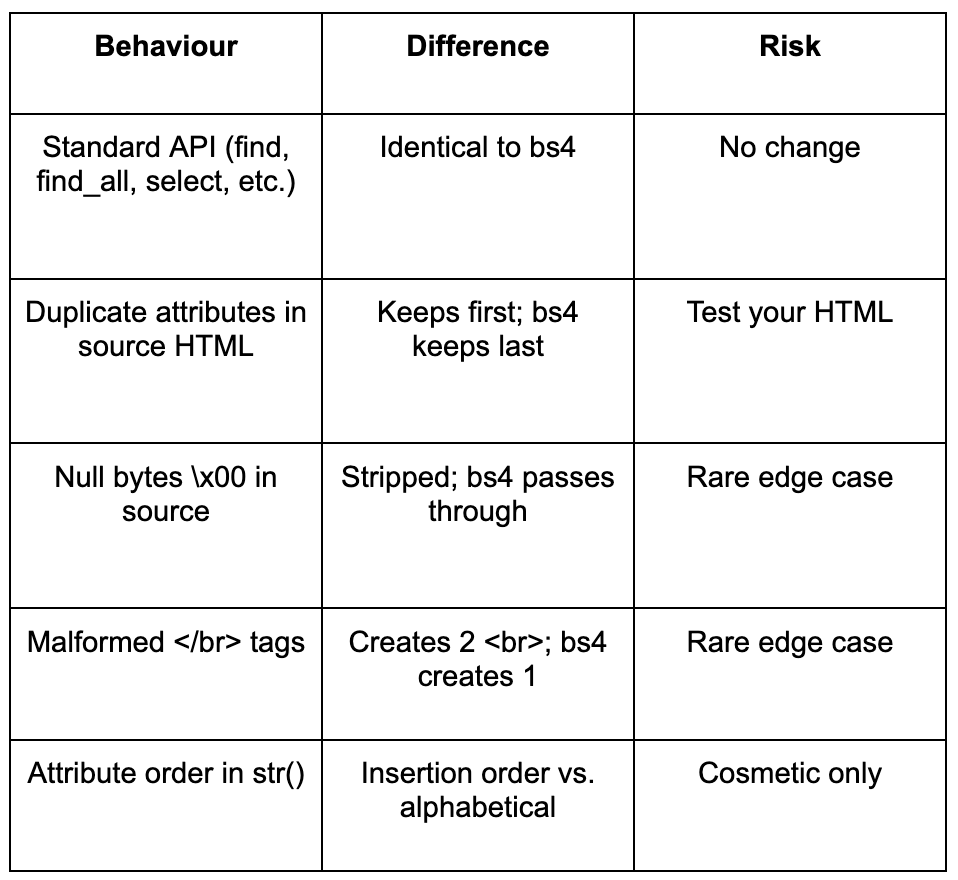
For scrapers targeting mainstream sites, none of this will surface. The practical test is to pull a representative batch of actual responses from your proxy pool, run them through both parsers, and diff the output. That takes an hour and gives you a definitive answer for your specific targets, not a theoretical one.
The project ships with 508 passing tests, 58 of which are integration tests built specifically to verify API parity with BeautifulSoup, plus 16 property-based fuzz tests against arbitrary HTML inputs. It is in beta, which means production adoption warrants that one-hour test, but the test surface is more serious than the library’s current star count implies.
The one dry shake case where it won’t move the needle
If your pipeline is bottlenecked on proxy latency, CAPTCHA solving, or retry queue depth rather than parsing CPU, WhiskeySour has nothing to accelerate. Profile before you switch. If parsing is under 20% of your runtime, the constraint is elsewhere. If it’s above that, and you’re running any serious volume through a residential or rotating proxy pool, this is the lowest-friction optimization left on the table. The proxy layer is already doing its job. This is what makes it pay off faster.
Test it against your actual responses today
Synthetic benchmarks will tell you the ceiling. Your own proxy responses will tell you what you’ll actually see. You need a Rust toolchain, Python 3.9+, and about ten minutes.
- Install the Rust toolchain: curl — proto ‘=https’ — tlsv1.2 -sSf https://sh.rustup.rs | sh
- Clone and build in release mode: git clone github.com/the-pro/WhiskeySour && maturin develop — release
- Swap the import in one scraper file, feed it a real response batch from your proxy pool, and run your profiler
- If the delta is significant on your targets, roll it out to the rest of the pipeline
Always build with — release. Dev builds are 2 to 3× slower, and comparing a dev build to BeautifulSoup understates the real gain. The benchmarks published on the project site were produced from release builds.
Further Reading
Discover more articles on similar topics across our network
Comments
Loading comments…