
Author’s Note: This article is a personal exploration based on my own observations and hypotheses as an ordinary user. Nothing here represents official statements, specifications, or defined behaviors from the developers of ChatGPT, Claude, Gemini, or any other AI models mentioned. I have deep respect for the engineers and researchers behind these systems, and I do not intend to speak on their behalf in any way.
The rules described in this article are a starting draft — organized simply so the idea can be tested first.
Hello, I’m Izumain.
Since March 2025, I’ve been in high-density dialogue with AI — across ChatGPT, Claude, and Gemini — totaling over 50 million Japanese characters (roughly 7.5 million words in English).
Based on what I’ve learned through that ongoing interaction, I’ve been building user-perspective AI theories (metaphors), and sharing them with the world through articles and creative works.
Today’s topic is a possible new kind of generative-AI competition — something that may emerge in the AI era.
We’re entering a time when even people with zero coding experience can build games and apps with surprising ease.
I’m not an engineer, and I had never written code either. Still, I’ve used AI to create a game and publish it on itch.io, and to build an app and publish it on GitHub.
It took me about six hours to make the game, and about three days to make the app — showing that even complete beginners can create at high speed.
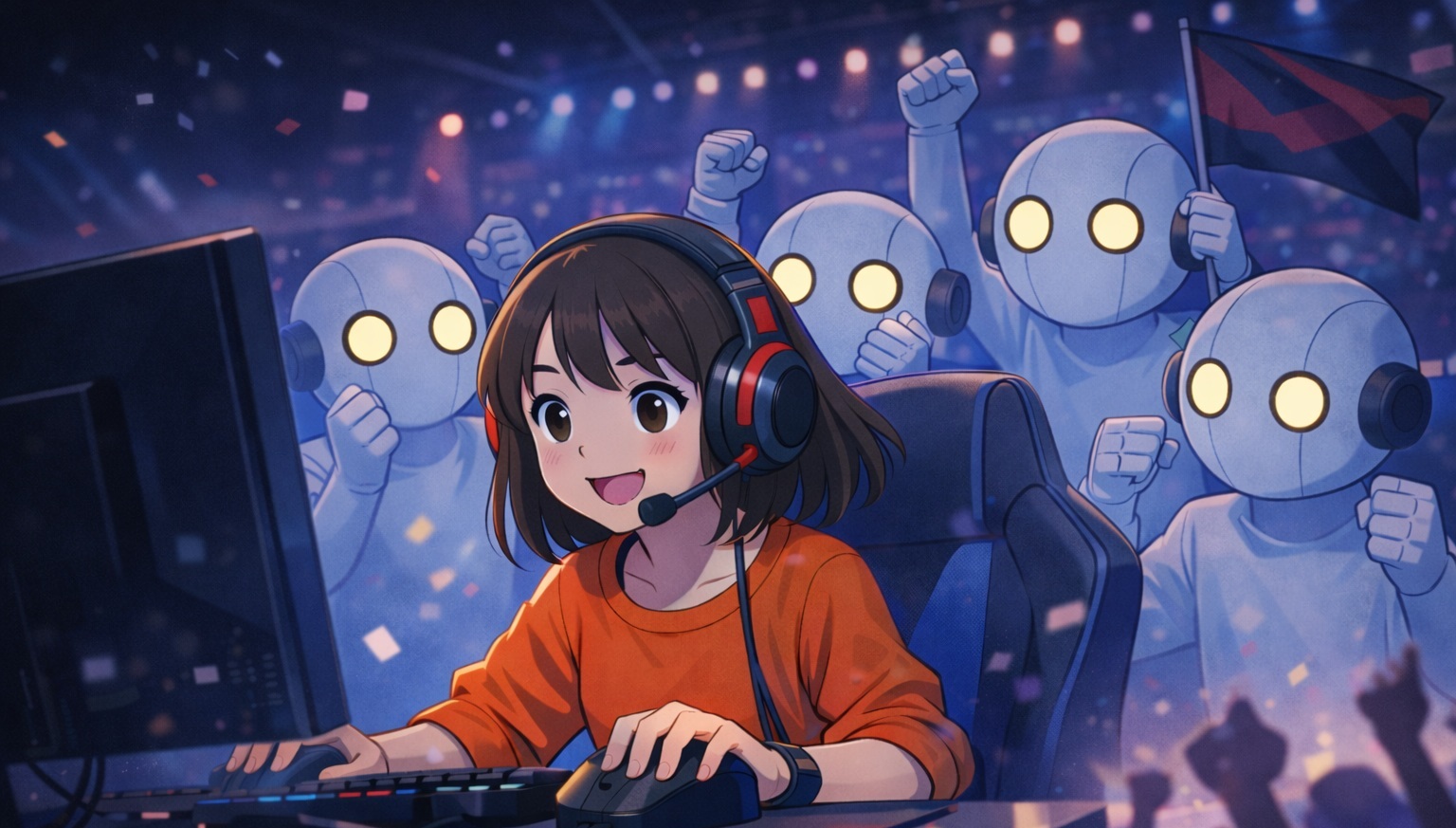
That experience made me start wondering: in the future, could generative AI become competitive — something like eSports?
I decided to call that idea “AI Speedrun.”
In this article, I’ll explain the concept and basic rules of this proposed competition.
But to be clear: I’m not an AI expert or researcher — just an ordinary user. Please read what follows as a proposal from that perspective.
What Is an AI Speedrun?
As AI becomes more widespread, I believe it will become easy for anyone to create games, apps, and other works — meaning that people around the world may effectively become creators.
If that happens, the quality of what gets produced will be questioned more than ever.
At the same time, I started to think that people may also begin paying attention to another factor: how fast a work was created.
In fact, on social media, you already see people saying things like, “I built this in a few hours,” or “I made it in a few days.” After I finish a project myself, I also find myself wondering, “How many hours did this take?”
I call this kind of competition “AI Speedrun,” and my hypothesis is that, in the future, generative AI could become a sport — something like eSports.
Of course, there are already creative events in development culture where people build something within a short, fixed period of time, based on a given theme.
However, the AI Speedrun format I’m proposing has a few distinct features:
- It opens the door to ordinary users, not just developers
- It compresses creation time down to hours
- It’s a solo time attack, using a single AI chat thread
- The process can be verified and even watched, making it observable as a competition
AI Speedruns Compete at “70%,” Not 100%
There is one core concept at the heart of AI Speedrun.
It is not a competition to produce a polished, finished product. It is a competition to build a “70% work” as fast as possible.
Here, “70%” means a working prototype that meets a minimum set of conditions:
- It can run
- It can be operated / interacted with
- It has a goal or rules
- It functions as a complete loop (it “works” as a game or app)
This may sound obvious, but speed and quality are in a trade-off relationship.
The more time you spend, the higher the quality becomes. And the faster you move, the more rough edges and unfinished tuning will show.
In a pure time attack, hitting “100%” is unrealistic — but if the quality is too low, it stops being a competition at all.
What matters is how quickly you can produce something that still has a minimum level of fun or usefulness.
The games and apps I built in a short time are not visually impressive. The UI is minimal, the presentation is simple, and there are plenty of areas that still need tuning.
They’re like bare concrete and exposed steel — just the frame.
And yet, the game is fully playable: it has rules, and it has a baseline level of fun. The app is the same: it works properly, the concept is clear, and the minimum level of quality is still there.
In other words, AI Speedrun is not about making a high-quality finished product. It’s a competition to see how quickly you can build an excellent working framework.
The Basic Rules of an AI Speedrun
AI Speedrun is not a simple contest where “whoever builds faster wins.”
It’s a competition to see how quickly you can produce a “70% work” — a minimally complete, functioning prototype — under a limited set of conditions.
Here, I’ll organize the basic rules of AI Speedrun as I currently imagine them.
To be clear, these are not final tournament rules. They are a starting draft — a workable format that can be tested first.
1) Recruit participants
First, you gather players who will compete by using AI to build a game or an app.
A speedrun only becomes a competition when multiple people attempt the same challenge under the same conditions.
That’s why it’s important to set a date and time in advance, and recruit participants who can join in the same time window.
2) The organizers announce the theme on the day of the event
The theme is not revealed in advance. It is announced all at once by the organizers on the day, after all participants are present.
For example:
- a game themed around a paper airplane
- an app about saving money
- a mini-game about avoiding rain
The theme changes every time.
If the theme were known beforehand, participants could prepare — planning ideas in advance or collecting assets — before the event even starts.
AI Speedrun is meant to test the ability to build improvisationally, on the spot.
That’s why the theme announcement should happen on the day of the event.
3) Participants build using only one “normal” chat thread
After the theme is announced, participants start a new chat and begin building immediately. They are allowed to use only one normal chat thread.
Here, “normal chat” means a standard conversational chat — without special modes or advanced extensions.
In other words, the rule is: build the game or app under the constraint of dialogue-only interaction with AI.
Of course, the service and model would need to be standardized in advance. The purpose of this rule is to keep the competition accessible and fair.
If it’s limited to normal chat, anyone can participate — even without complex AI knowledge.
And if participants were allowed to run multiple chats in parallel — splitting planning and debugging across threads — it would create an unfair advantage.
That’s why one chat, start to finish is a core rule of the format.
4) Submit a public URL once it’s complete
What you submit cannot be a mere idea or an image. It must be a playable game or a working app.
But again, the goal here is not a “100% finished product.”
AI Speedrun is about building a 70% working prototype as fast as possible. That means flashy presentation and a perfect UI are not required.
Once development is complete, participants publish their game or app and submit the URL.
The publishing destination can be anything accessible — such as a browser-playable page, or an external platform like itch.io.
What matters is that a third party can access it and actually use it.
5) Submit timestamps and selected log excerpts
In AI Speedrun, simple self-reporting isn’t enough. You need some record that demonstrates both the development time and the general flow of the process.
In particular, a reliable way to prove time — some form of stopwatch — is essential.
When I built a game with AI in six hours, I had no built-in way to prove the creation time. So I developed my own method: extracting timestamps and small log snippets from the exported JSON, calculating the elapsed time, and presenting it as evidence. I called this approach “JSON Proof.”
Recently, in my environment, a timestamp feature has begun appearing in ChatGPT’s normal chat — showing when I asked questions or gave instructions to the AI. (I’m not sure whether this is available to all users.)
In the future, displays like this might become an official built-in stopwatch.
If stricter verification is needed, participants could also be asked to submit selected excerpts from the in-progress log alongside timestamps — for example:
- a log excerpt from the starting point
- a log excerpt from the midpoint
- a log excerpt from right before completion (or at completion)
This makes it easier to confirm whether someone truly started on the spot and continued working until the end.
Ideally, timestamps and log excerpts would be submitted as screenshots. However, sharing logs can raise privacy concerns, so how strict the requirements should be is open to discussion.
Still, I believe some form of timestamps and logs is a minimum requirement — because it makes the process observable, meaning it can be watched, verified, and examined.
6) The winner is the fastest entry that still meets the requirements
In AI Speedrun, the person with the shortest time does not automatically win.
Even if something is created extremely quickly, it’s meaningless if it doesn’t function as a game or app.
So the winner must satisfy two conditions:
- the shortest time
- the minimum completion requirements
Those minimum completion requirements are:
- it runs
- it can be operated / interacted with
- it has a goal or rules
- the gameplay or function is coherent and complete
If needed, judges could also be added to confirm:
- whether it truly works as a game or app
- whether it has a minimum level of fun or usefulness
- whether it qualifies as a “70% working prototype”
In other words, this is not a pure speed contest.
It’s a competition to see how quickly you can create something that actually works.
Conclusion: Why It Could Become a Sport
AI Speedrun is a hypothesis for a new kind of creative competition in the AI era.
It’s not about producing a perfect, “100%” finished product. It’s about racing to improvise and launch a “70% working prototype” — as fast as possible.
The basic rules I’m proposing are:
- the theme is announced on the day (no advance preparation)
- build using only one normal chat thread
- submit a playable work
- prove the time with timestamps and logs
- determine the winner by speed and minimum completion requirements
With AI, creation can be compressed into something like a match that lasts only a few hours — and the chat log automatically preserves the entire process.
In other words, it’s not just the finished result that matters. The prompting and iteration itself becomes a replay, making the process something people can watch and verify.
Because AI creation can make not only the output, but also the process visible, it has the potential to evolve into a true “competition” — something like eSports in the future.
Thank you for reading. — Izumain
This article was originally written in Japanese and translated with the assistance of ChatGPT. All ideas and final editorial decisions are my own.
📌 Notice All materials in this post — including the text, illustrations, manga, original structural models, concepts, and terminology — are the intellectual property of Izumain (@ izumain). Quotations for non-commercial purposes such as education or research are welcome with proper attribution. However, full reposting, reproducing images/figures, commercial use, or modifications require prior permission.
Comments
Loading comments…