
Strategic sourcing no longer refers to finding the lowest price. You need to set up a robust, intelligent, and flexible network that keeps the global economy moving even when the world gets unpredictable. In today’s market, a smart sourcing strategy is the difference between a company that thrives during a crisis and one that disappears.
Overview of Strategic Sourcing in Global Trade
If you’ve ever wondered how your favorite smartphone or that specific brand of coffee always seems to be available despite global turmoil, the answer lies in strategic sourcing.
Unlike traditional buying, which is often reactive and transactional, strategic sourcing is a high-level game of chess. It involves analyzing what a company buys, from whom, at what price, and, most importantly, how that purchase fits into the long-term health of the business.
In the realm of global trade, this means looking past the immediate horizon. It’s about understanding that a factory in Vietnam, a shipping lane in the Suez Canal, and a warehouse in Belgium are all interconnected. By the time we reach the end of 2026, the complexity of these connections has only deepened, making a strategic approach a survival requirement.
Evolution of Global Trade Models
The way we trade globally has undergone a massive facelift over the last few decades. We’ve moved from simple bilateral trades to a web of interconnected global value chains.
Traditional Sourcing vs. Strategic Sourcing
To understand where we are, we have to look at where we started. Traditional procurement was basically shopping. You had a list of things you needed, you found someone who sold them, and you tried to get them to lower the price. It was a win-lose scenario where the buyer wanted the lowest cost, and the seller wanted the highest profit.
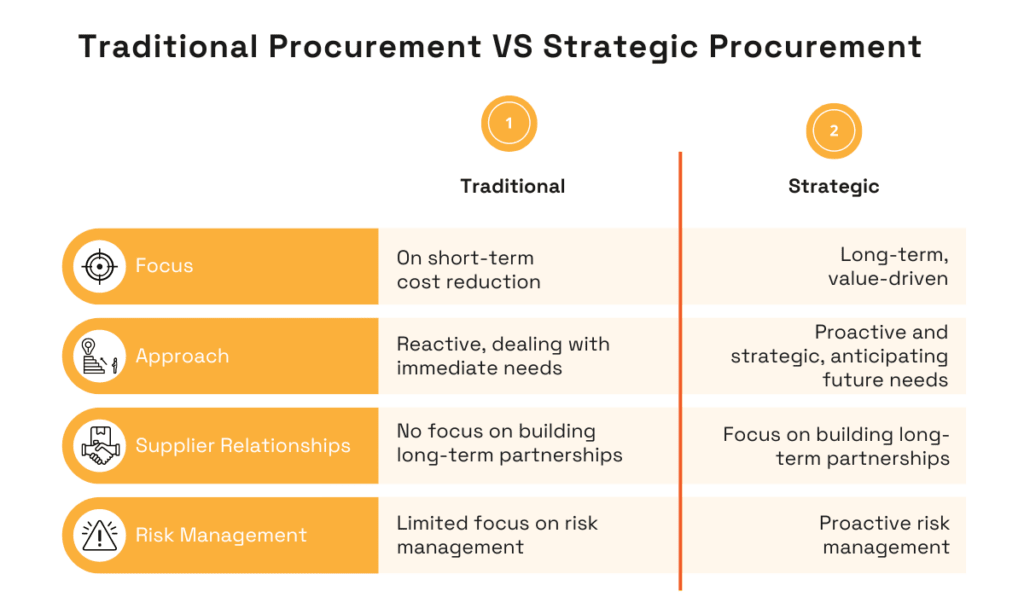
Source: Veridion
Strategic sourcing, however, turns this on its head. It’s a holistic process. Instead of just looking at the price tag, a strategic sourcer looks at the "Total Cost of Ownership." This includes shipping, taxes, the risk of delays, and even the cost of the carbon footprint.
Sharon Amos, Director at Air Ambulance 1, explains that “In mission-critical operations, the cheapest option is rarely the safest choice. Strategic sourcing means evaluating reliability, response time, and long-term partnership value rather than focusing solely on price.”
Shift Toward Value-Driven Partnerships
We are seeing a move away from adversarial relationships toward value-driven ones. In the old days, if a supplier struggled, the buyer just found a new one. Today, buyers often work with their suppliers to improve their processes.
For example, a major automotive manufacturer might send its own engineers to a supplier's factory to help them implement lean manufacturing techniques. This lowers the supplier's costs, which in turn lowers the buyer's price, and creates a bond that makes the supply chain much harder to break during a recession or a pandemic.
Psychology of Supplier Collaboration
The shift toward strategic sourcing isn't just about changing software; it’s about changing mindsets. In the past, procurement was often seen as a "police" function—focused on catching errors and slashing budgets. Today, the most successful global trade models treat suppliers as an extension of their own team. This psychological shift is crucial because, in times of global shortage, a supplier will prioritize the buyer they have a genuine relationship with over the one who only calls to complain about prices.
Raphael Yu, CMO at EaseSourcing, notes that “Strategic sourcing today is less about simply locating suppliers and more about building resilient global partnerships. Companies that collaborate closely with suppliers on forecasting, production planning, and logistics gain far more stability than those focused purely on cost negotiations.”
For instance, a small electronics manufacturer might give their preferred partner a heads-up about a raw material shortage two weeks before it becomes public knowledge. This soft data gathered through human rapport is often just as valuable as the hard data gathered by AI.
Key Components of Strategic Sourcing
What makes a sourcing strategy actually strategic? It boils down to a few core pillars that transform a simple purchase into a long-term asset.
-
Data-Driven Decision Making
In 2026, if you aren't using data, you're just guessing. Strategic sourcing relies on massive amounts of data, everything from commodity price fluctuations to the historical reliability of shipping ports. By analyzing this data, companies can spot trends before they become problems.
Logan Peranavan, CEO of TapestoDigital UK, notes that “Data-driven decision making is essential in procurement. Organizations that use analytics to track suppliers, market trends, and risks can make faster and more informed sourcing decisions.”
Industry research shows that companies utilizing advanced data analytics in their sourcing processes can reduce their external spend by an average of 12% annually compared to those using manual methods.
-
Supplier Relationship Management
This is the human side of the equation. Supplier Relationship Management (SRM) is the practice of segmenting your suppliers based on how critical they are to your business. You don't need a deep, strategic partnership with the company that sells you office pens, but you absolutely need one with the company that provides the specialized microchips for your flagship product.
-
Cost Optimization Strategies
Cost optimization isn't just about cutting costs; it's about optimizing them. Sometimes, paying more for a local supplier is actually cheaper in the long run because it eliminates the risk of international shipping delays and expensive air-freight emergencies.
-
Risk Assessment and Mitigation
Every global trade route has a risk profile. Strategic sourcing involves mapping out these risks, whether political instability, natural disasters, or fluctuating currency exchange rates, and having a “Plan B” (and even a Plan C) ready to go.
Rachel Sinclair, Acquisitions Director at US Gold and Coin, notes that “Commodity sourcing requires constant monitoring of geopolitical and supply risks. Companies that diversify suppliers and track market signals early are far better equipped to manage volatility.”
Impact of Strategic Sourcing on Global Supply Chains
The way companies source their goods directly dictates the shape of the global economy. As businesses get smarter, the map of global trade changes.
-
Diversification of Supplier Bases
The phrase "don't put all your eggs in one basket" is the golden rule of 2026. After several years of global disruptions, companies are moving away from relying on a single country, often referred to as the "China Plus One" strategy.
By spreading their sourcing across multiple regions, like India, Mexico, and Vietnam, companies ensure that a localized disaster doesn't wipe out their entire inventory.
-
Nearshoring and Reshoring Trends
We are seeing a massive trend toward bringing production closer to home. This is nearshoring (sourcing from a neighboring country) or reshoring (bringing it back to the home country).
A clothing brand based in California might move its manufacturing from East Asia to Mexico. While the labor might be slightly more expensive, the shipping time drops from five weeks to three days, allowing the brand to react much faster to changing fashion trends.

Source: NewStreaming
-
Strengthening Supply Chain Resilience
Resilience is the ability to bounce back. Strategic sourcing creates this by building flexibility into the system. This might mean keeping a safety stock of critical components or having pre-negotiated contracts with backup suppliers that can be activated at a moment's notice.
Technology’s Role in Strategic Sourcing
Technology is the engine that allows strategic sourcing to function at scale. Without it, the strategy would just be a pile of unread spreadsheets.
AI and Predictive Analytics
AI is the crystal ball of procurement. It can scan millions of news articles, weather reports, and financial statements to predict a supplier's bankruptcy or a regional strike months before it happens. This allows sourcing managers to shift their orders to a safer location before the crisis even hits the headlines.
Procurement Automation Platforms
Automation handles the boring stuff, issuing purchase orders, tracking invoices, and verifying shipping documents. This frees up human procurement professionals to focus on high-level negotiations and relationship building.
Real-Time Supply Chain Visibility
"Where is my stuff?" used to be a hard question to answer. Now, through IoT sensors and blockchain technology, a sourcing manager can see exactly where a container is on the ocean, the temperature inside that container, and even the vibration levels the goods are experiencing. This level of transparency makes it much easier to hold suppliers and carriers accountable for the quality of their service.
This level of transparency makes it much easier to hold suppliers and carriers accountable for the quality of their service.
Cost Efficiency and Competitive Advantage
At the end of the day, businesses exist to make a profit. Strategic sourcing provides a competitive edge that is very difficult for competitors to replicate.
Total Cost of Ownership (TCO) Approach
TCO is the secret sauce of strategic sourcing. It looks at the price of the item, plus the cost of shipping, insurance, customs duties, warehousing, and even the hidden costs like the time spent by employees managing a difficult supplier.
A manufacturing firm might find that a $10 part from a local supplier is actually cheaper than a $7 part from overseas once you factor in the $4 per part cost of shipping, tariffs, and the risk of a 2-week delay.
Christian Lyche, Founder and CEO of Gold Standard Auctions, notes that “Markets built around physical assets demonstrate how quickly value can shift when supply tightens or demand spikes. Companies that understand real market pricing and long-term asset value are better equipped to make strategic sourcing decisions.”
Long-Term Contract Negotiations
Strategic sourcing favors long-term stability over short-term wins. By signing three-to-five-year contracts, buyers can lock in prices and ensure they are the priority customer when supplies get tight. In exchange, suppliers get the financial security they need to invest in better machinery or more staff.
Performance Benchmarking
You can't improve what you don't measure. Strategic sourcers use Key Performance Indicators (KPIs) to track supplier performance. This includes "On-Time Delivery" rates, "Defect Rates," and even "Sustainability Scores."
Sustainability and Ethical Sourcing
In 2026, consumers and regulators alike are demanding that products be made responsibly. Strategic sourcing is the tool used to ensure that these standards are met.
ESG Compliance in Procurement
Environmental, Social, and Governance (ESG) criteria are now a standard part of supplier evaluations. Companies are no longer just looking at a supplier's balance sheet; they are looking at their carbon emissions, their waste management practices, and how they treat their workers.
Responsible Supplier Selection
Strategic sourcing involves auditing suppliers to ensure they don't use forced labor or engage in environmentally destructive practices. This is about protecting the brand. One scandal in a remote factory can cause a company's stock price to plummet and lead to massive consumer boycotts.
Reducing Environmental Impact
By choosing suppliers who use renewable energy or by optimizing shipping routes to be as short as possible, strategic sourcing directly contributes to a company's "Net Zero" goals.
Recent data from global trade monitors indicates that logistics-heavy companies can reduce their total carbon footprint by up to 18% simply by switching to AI-optimized green shipping lanes and localizing their supply hubs.
Strategic Sourcing in the Circular Economy
As we move deeper into 2026, strategic sourcing is expanding to include the "end-of-life" phase of products. This is known as the Circular Economy. It’s no longer enough to source a product ethically; companies are now strategically sourcing materials that can be easily reclaimed, recycled, or refurbished.
This creates a closed-loop system that reduces the need for constant virgin raw materials, which are often subject to the most volatile price swings and geopolitical risks.
A great example of this is seen in the smartphone industry. Leading brands are now sourcing specific aluminum alloys and rare earth magnets from specialized recycling partners rather than mining them from new locations. This doesn't just lower the environmental impact; it provides a stable, predictable supply of materials that isn't affected by overseas port strikes or foreign mining regulations.
Challenges in Implementing Strategic Sourcing
If it were easy, everyone would do it perfectly. The transition to a truly strategic model is full of obstacles.
Geopolitical Risks
Trade wars, sanctions, and shifting alliances can turn a perfect sourcing strategy into a nightmare overnight. Strategic sourcing requires a deep understanding of global politics and the ability to pivot when a trade route is suddenly closed or a new tariff is introduced.
Regulatory Compliance
As global trade laws become more complex, especially regarding data privacy and environmental standards, staying compliant is a full-time job. A sourcing manager must ensure that every single supplier in their chain is following the laws of both the origin and the destination countries.
Supplier Dependency Issues
There is a fine line between a "strategic partnership" and "dependency." If a company becomes too reliant on a single supplier, that supplier gains too much leverage in negotiations.
Future of Strategic Sourcing in Global Trade
The next decade of sourcing will be defined by agility. The days of five-year plans that never change are over.
Digital Procurement Transformation
We are moving toward autonomous sourcing, where AI bots will handle low-to-medium value negotiations entirely on their own, using real-time market data to get the best deal without human intervention. This shift is transforming the role of procurement professionals, allowing them to focus more on strategic planning and supply chain architecture rather than routine purchasing tasks.
Collaborative Global Partnerships
The future will see more "Co-opetition", where even competing companies might share a warehouse or a shipping vessel to reduce costs and environmental impact. Strategic sourcing will facilitate these complex, multi-party agreements.
Adaptive and Agile Sourcing Models
The ultimate goal is a Self-Healing Supply Chain. This is a system where the sourcing strategy automatically adjusts based on real-world events. If a factory in Taiwan is offline for a day, the system automatically redirects the order to a facility in South Korea without a human having to click a single button.
Conclusion
Strategic sourcing has evolved from a back-office administrative task to a front-and-center executive priority. It is the framework that allows a business to navigate the choppy waters of global trade with confidence. By combining deep data analysis with strong human relationships and a commitment to sustainability, companies aren't just buying products; they are building a foundation for future growth. The world of 2026 is interconnected and fast-paced, and strategic sourcing is the map that helps us find the way.
Comments
Loading comments…