By Kovalov Illia, Product Manager in the IT Industry, United States of America
Abstract
This article explores a risk-oriented approach to software quality assurance as a practical instrument of product management. It demonstrates how QA metrics (defect leakage, feedback loop speed, release stability, reliability indicators) can be translated into the language of product decisions: backlog prioritization, release risk management, and forecasting the impact of quality on conversion and retention.
Based on multiplatform projects (including medical software subject to HIPAA/FDA requirements), the paper describes principles for building quality gates and risk matrices that reduce the cost of defects and increase delivery predictability. A model is proposed in which QA acts not only as a control function but as an integral part of product strategy, directly connected to business growth and sustainability.
Keywords
quality management; risk-based testing; product metrics; defect leakage; quality gates; medical software; HIPAA; FDA; e-commerce; reliability
Introduction
In conditions of high competition and accelerated development cycles, quality becomes not only an “engineering characteristic” but also a factor of product economics. Defects affect conversion, returns, customer support, legal risks, and the team’s ability to deliver changes predictably. This is especially critical for medical software, where system reliability and correctness are directly tied to regulatory compliance requirements (e.g., HIPAA/FDA), and for e-commerce, where UX or stability degradation immediately impacts revenue.
1. Risk as the Unit of Quality Management
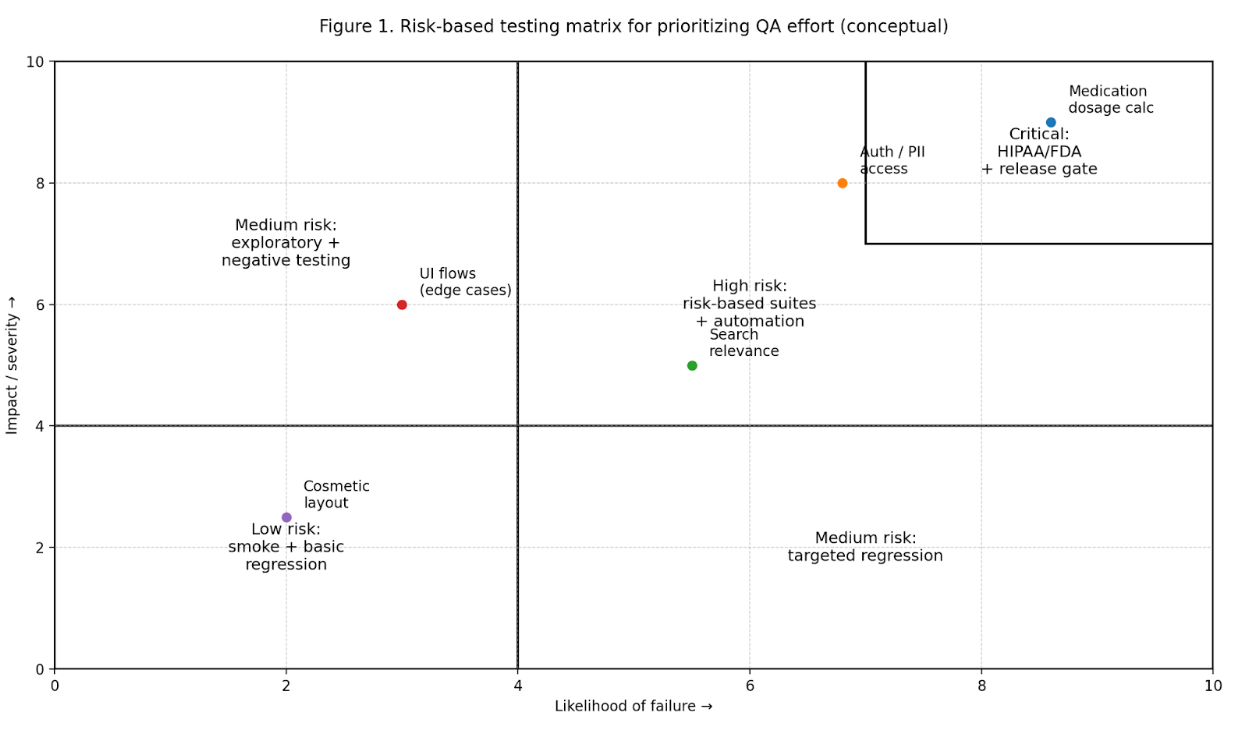
The risk-oriented model views quality through a combination of two parameters:
- likelihood of failure — how often a scenario breaks;
- impact severity — the cost of an error for users, the business, and regulatory compliance.
The practical value of this model lies in its ability to:
- move away from “uniform” coverage of the entire product;
- focus resources on areas where defects are most expensive;
- explain priorities not through “QA opinion,” but through transparent, controllable criteria.
2. From QA Metrics to Product Decisions
For QA to become part of product strategy, metrics must be directly linked to decisions:
- Defect leakage (defects escaping to production) → adjustment of release rules, strengthening of critical tests, revision of “definition of ready/done.”
- Mean time to detect / fix → improvements in observability, logging, and alerting, faster feedback loops.
- Crash rate / latency → prioritization of technical backlog on par with feature development.
- Regression pass rate → release risk forecasting and delivery calendar management.
In medical projects, additional emphasis is placed on provability and traceability: requirements-to-test alignment, reproducibility of results, access control, and proper data handling.
3. Quality Gates as a Managerial “Safety Net”
“Quality gates” refer to a system of control points that determine whether the product can move further along the pipeline (release, rollout, audience expansion) or requires stabilization.
Key principle: Gates must be measurable and agreed upon in advance—as product rules, not ad-hoc decisions.
Typical logic:
- Early stage: risk review of requirements and test plan;
- Mid-stage: unit and integration testing;
- Closer to release: regression, end-to-end testing, and security checks;
- Pre-release: “release readiness” check with minimally acceptable thresholds.
4. Practical Model for Team Implementation
A universal sequence for implementing a risk-oriented quality system:
- Describe critical user flows and “cost-of-error points”;
- Build a risk matrix and identify “critical zones”;
- Define quality gates and measurable thresholds;
- Embed metrics in a regular cycle (weekly quality review + release review);
- Link metrics to decisions: priorities, deadlines, release constraints, and automation investments.
Conclusion
Risk-oriented quality management allows QA work to be directly connected to product economics: reducing defect costs, accelerating feedback loops, and increasing delivery reliability. For medical software, it additionally ensures provable compliance; for e-commerce, it protects conversion and retention. In this model, QA becomes not a support function but an integral part of product strategy and a tool for managed growth.
References
- ISTQB. Foundation Level Syllabus (latest version).
- Kaner, C., Bach, J., Pettichord, B. Lessons Learned in Software Testing.
- Google. Site Reliability Engineering: How Google Runs Production Systems.
- Fowler, M. Continuous Delivery (articles and materials on practices).
- ISO/IEC 25010. Systems and software Quality Requirements and Evaluation (SQuaRE).