How the convergence of artificial intelligence, Model Context Protocol, and modern BI tools is fundamentally reshaping the role of data analysts — and why this might be the most exciting time to be in data
The morning coffee hasn’t even cooled when Sarah, a senior data analyst at a Fortune 500 company, asks her AI assistant to pull last quarter’s sales data, cross-reference it with market trends, generate a Power BI dashboard, and prepare a executive summary — all in natural language. Ten minutes later, she’s presenting insights that would have taken her team three days to compile just two years ago.
This isn’t science fiction. This is the reality of data analytics in 2026, where the convergence of Power BI, Model Context Protocol (MCP), and artificial intelligence has created a perfect storm of transformation. But unlike the doom-and-gloom headlines suggesting AI will replace analysts, the truth is far more nuanced — and far more exciting.
The Trilogy of Transformation
To understand where we’re headed, we need to understand the three forces reshaping our field:
From dashboards to decisions — where Power BI, open AI standards, and intelligent models converge to redefine modern analytic
MCP: The Silent Revolution
If you haven’t heard of Model Context Protocol yet, you’re not alone. But this Anthropic-developed standard is quietly becoming the connective tissue of the AI-powered analytics ecosystem.
MCP is essentially a universal translator that allows AI models to talk to your databases, BI tools, APIs, and business applications in a standardized way — without building custom integrations for every single connection.
Think of MCP as USB-C for AI. Before USB-C, every device needed its own proprietary cable. MCP does the same thing for AI-to-tool communication. Instead of building separate connectors for Power BI, Salesforce, PostgreSQL, and hundreds of other tools, MCP provides a single protocol.
What This Means for Power BI Users
Power BI has always been powerful, but it required analysts to know DAX, understand data modeling, and spend hours building visualizations. With MCP-enabled AI assistants:
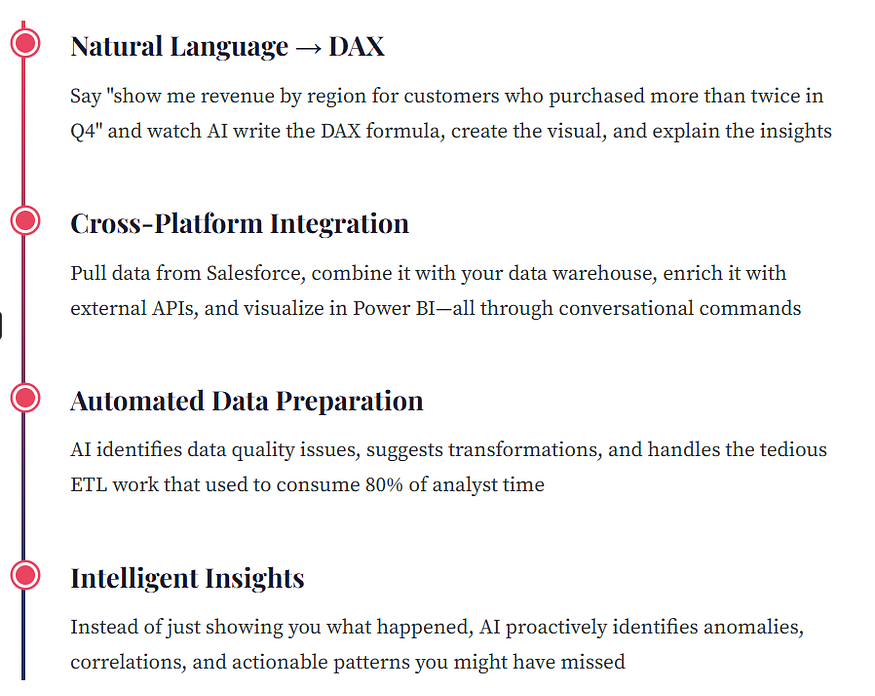
From natural language to insights — AI automates DAX, data integration, preparation, and discovery.
The New Analyst Workflow
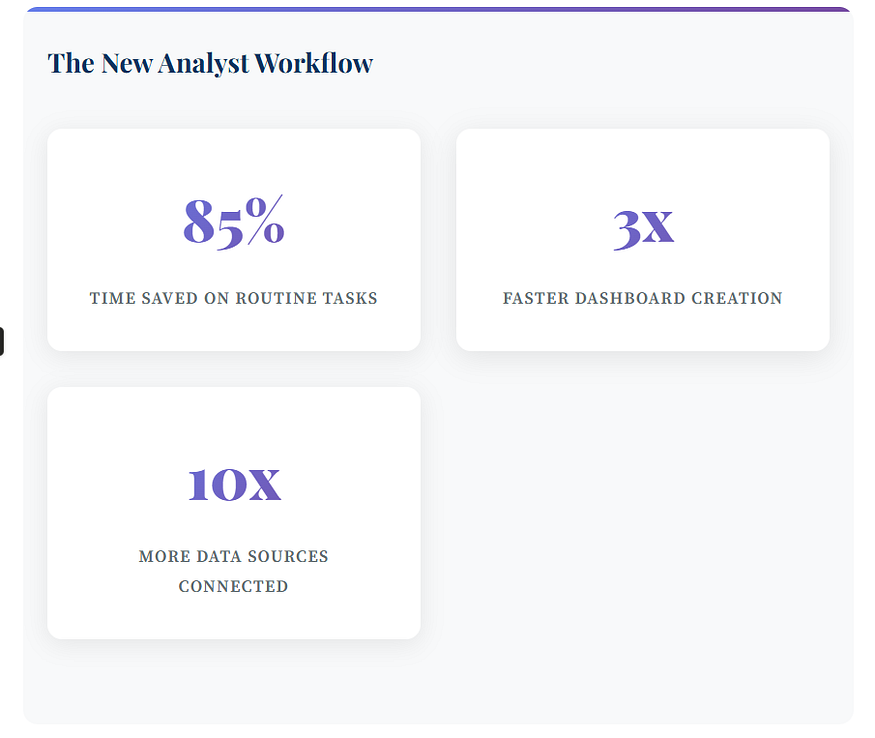
From Report Builders to Strategic Storytellers
Here’s the paradigm shift: AI isn’t replacing data analysts — it’s elevating them.
The mundane work — data cleaning, basic queries, standard reports — is being automated. But this liberation creates space for what humans do best: strategic thinking, contextual understanding, and narrative crafting.
The future data analyst is less of a technical operator and more of a strategic translator — someone who understands both the business context and the data possibilities, using AI as a force multiplier rather than a replacement.
The Emerging Skill Set
The analysts thriving in this new landscape are developing a unique combination of skills:
1. Prompt Engineering for Analytics Knowing how to ask the right questions to AI systems. It’s not just about technical queries — it’s about framing problems in ways that generate actionable insights.
2. AI-Augmented Data Literacy Understanding what AI can and can’t do, where its insights are reliable, and when human judgment needs to override algorithmic suggestions.
3. Business Context Mastery AI can find patterns, but it takes human expertise to know which patterns matter. Deep business knowledge is becoming more valuable, not less.
4. Narrative & Visualization Design With AI handling technical execution, the ability to craft compelling data stories and design intuitive visualizations becomes a key differentiator.
// Example: MCP-enabled Power BI interaction (C-style pseudocode)

#include <stdio.h>
#include <string.h>

// --- Data Structures ---

typedef struct {
    char context[64];
    char request[512];
    const char *tools[3];
    int tool_count;
    char format[64];
} MCPQuery;

typedef struct {
    char summary[2048];
} MCPResponse;

// --- Mock MCP Client API ---

MCPResponse claude_query(MCPQuery query) {
    MCPResponse response;

    // Simulated AI-generated output
    strcpy(
        response.summary,
        "Top 5 underperforming products in EMEA identified. "
        "Correlation with low customer satisfaction detected. "
        "Power BI dashboard generated with DAX measures, visuals, "
        "and strategic recommendations."
    );

    return response;
}

// --- Main Program ---

int main() {
    MCPQuery analysis = {
        .context = "sales_database",
        .request =
            "Identify top 5 underperforming products in EMEA region, "
            "correlate with customer satisfaction scores, and generate "
            "Power BI dashboard with recommendations",
        .tools = {
            "powerbi_connector",
            "salesforce_mcp",
            "sentiment_analyzer"
        },
        .tool_count = 3,
        .format = "executive_summary"
    };

    MCPResponse result = claude_query(analysis);

    // Output AI-generated insights
    printf("Executive Summary:\n%s\n", result.summary);

    return 0;
}

/*
 AI coordinates across multiple systems:
 - Pulls data via MCP tools
 - Generates DAX expressions
 - Builds Power BI visualizations
 - Delivers executive-level recommendations
*/
The Reality Check: Challenges Ahead
Let’s be honest — this transformation isn’t without friction:
Data Governance Gets Complex When AI can access and combine data from dozens of sources, ensuring privacy, compliance, and security becomes exponentially harder. Organizations need robust governance frameworks.The Trust Question How do you verify AI-generated insights? When an AI identifies a trend or makes a recommendation, analysts need tools and methods to validate those findings.Skill Gaps and Reskilling Not every analyst is ready for this shift. Organizations must invest in training programs that help traditional analysts develop AI-collaboration skills.Cost and Infrastructure Enterprise-grade AI systems, MCP implementations, and the compute power they require represent significant investment. Not every organization can move at the same pace.
Technology Stack: The Modern Data Analyst’s Arsenal

A Day in the Life: 2026 vs 2023
2023: The Traditional Analyst
9:00 AM — Receive request for quarterly sales analysis 9:30 AM — Query database, export to CSV 10:00 AM — Clean data in Excel, identify inconsistencies 11:30 AM — Build Power BI data model 1:00 PM — Create DAX measures 3:00 PM — Design visualizations 4:30 PM — Write summary findings Result: One basic dashboard, 7 hours of work
2026: The AI-Augmented Analyst
9:00 AM — Describe analysis needs to AI assistant in natural language 9:15 AM — Review AI-generated Power BI dashboard with preliminary insights 10:00 AM — Deep dive into unexpected patterns AI identified 11:00 AM — Use AI to create scenario models and predictive analytics 12:00 PM — Collaborate with business leaders to refine strategic recommendations 2:00 PM — Present comprehensive analysis with interactive dashboards Result: Multi-dimensional analysis with predictive models, strategic recommendations, 5 hours of high-value work
The Path Forward: Adaptation Strategies
If you’re a data analyst reading this and feeling both excited and anxious, here’s your roadmap:
Embrace the Learning Curve Start experimenting with AI tools now. Use ChatGPT or Claude to help write DAX formulas. Try natural language queries in Power BI. Build familiarity with MCP-enabled tools.
Develop Your Unique Value Identify what makes your analysis valuable beyond technical execution. Is it industry knowledge? Stakeholder relationships? Creative problem-solving? Double down on those human advantages.
Build Cross-Functional Bridges The analysts who will thrive are those who can translate between technical possibilities and business needs. Strengthen those translation skills.
Stay Curious About AI You don’t need to become an AI engineer, but understanding how these systems work, their limitations, and their potential will make you a more effective AI collaborator.
The Future Is Collaborative, Not Competitive
The question isn’t whether AI will change data analytics — it already has. The question is how we’ll adapt, evolve, and ultimately thrive in a world where human insight and machine intelligence work in concert.
Closing Thoughts: Why This Is the Best Time to Be a Data Analyst
Counterintuitive? Perhaps. But consider this: we’re moving from an era where analysts were bottlenecked by technical constraints to one where the only limit is imagination and strategic thinking.
The integration of Power BI, MCP, and AI isn’t making analysts obsolete — it’s making them superhuman. It’s democratizing advanced analytics, yes, but it’s also creating opportunities for analysts to work on problems that were previously impossible to tackle at scale.
Want to analyze customer sentiment across 50 million social media posts and correlate it with sales data in real-time? The tools exist now. Want to build predictive models that auto-update as new data streams in? It’s doable. Want to create personalized dashboards for 10,000 employees, each showing their relevant metrics? AI makes it practical.
The data analysts who will define the next decade aren’t necessarily the best at SQL or DAX — they’re the ones who can envision what’s possible, ask the right questions, and turn AI-generated insights into business transformation.
This is our Gutenberg moment. The printing press didn’t make writers obsolete — it created an explosion of new forms of written expression. Similarly, AI won’t replace analysts; it will enable a Cambrian explosion of data-driven insights and decision-making.
The revolution is here. The tools are ready. The only question is: are you?
Comments
Loading comments…