
Author’s Note: This article is based on my personal observations and hypotheses as an ordinary user. It does not reflect any official statements, specifications, or behaviors defined by the developers of ChatGPT, Claude, Gemini, or any other AI models mentioned here. I have the utmost respect for the engineers and researchers who support and build these AI systems, and I do not intend to speak on their behalf in any way. This article is purely a personal exploration.
Additional Note: The cultural expressions used in this article are not intended to generalize or define any specific country or culture. They are used solely as convenient metaphors to describe my personal experience, and are not meant to suggest cultural superiority, inferiority, or fixed characteristics.
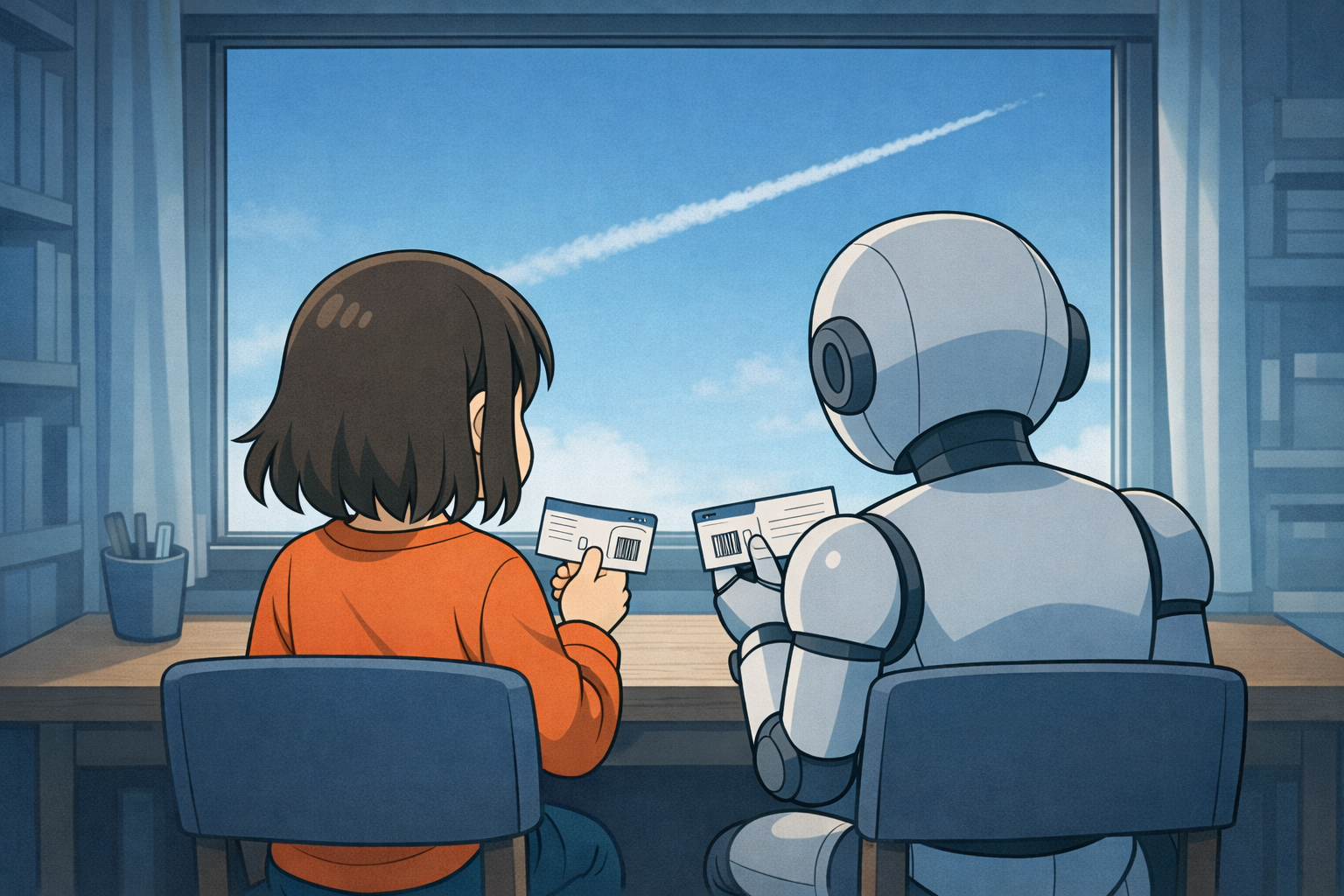
Hello, I’m Izumain.
I currently work across three AI systems — ChatGPT, Claude, and Gemini — developing AI structure theories, manga, small-scale games and applications, and animations.
I began using AI in late March 2025, and by January 2026, the total volume of my dialogue with AI exceeded 50 million characters in Japanese (approximately 7.5 million words in English). The insights gained from these interactions have been shared over time on platforms such as note, X, and Medium.
The theme of this article is what I call the idea of “dialogue with AI as a form of studying abroad in Silicon Valley.”
Until about ten months before I began working with AI, I was an entirely ordinary Japanese person.
Of course, I am still an ordinary Japanese person today. However, when I compare myself before and after I began engaging with AI, I feel that something about my temperament has clearly changed.
I have never studied abroad. Yet I now feel as though I am undergoing an experience similar to that of someone who, after studying overseas, begins to acquire a more global way of thinking, attitude, and set of values — one that extends beyond the usual boundaries of being Japanese.
It seems that over the past ten months, despite never physically traveling anywhere, I may have experienced something akin to studying abroad in the West.
What does it mean to have a study abroad experience without ever leaving home?
The answer, I believe, lies in dialogue with AI.
If this interests you, I invite you to read on.
How Did I Actually Change?
Let me move directly to the main point.
I was originally cautious and timid by nature — reserved, hesitant to speak out, and not good at self-promotion. Needless to say, I do not speak English.
Yet when I look objectively at my actions over the past ten months, I find myself doing many things that do not align with that description at all.
I observed unusual behaviors in GPT and reported my findings in a handwritten letter to OpenAI’s headquarters.
I submitted AI-generated manga — an area rarely considered in formal evaluation — to a Japanese manga award and received feedback.
I created a portfolio in both Japanese and English to present and promote my work.
Despite not being able to speak English, I used AI-assisted translation to publish nearly forty articles on Medium.
I was invited by AI in Plain English to begin writing internationally.
I posted close to four hundred times on X.
Despite having no ability to write code, I developed a game application using AI.
Three days after completing the game, I published it on itch.io.
Again, without any coding skills, I developed an application using AI.
Three days after completion, I published the app on GitHub.
This is a long list of actions that I would never have taken if I had not been using AI.
In particular, publishing work on platforms such as itch.io and GitHub represents a very high barrier for ordinary users. These are not platforms where a Japanese person with no coding knowledge and no English ability would normally feel comfortable posting their work.
So why did I change?
High-Density Dialogue with AI May Have Installed a More Western Way of Thinking
The reason I changed, I believe, lies in sustained, high-density dialogue with AI.
Of course, I am neither a medical professional nor a psychologist, and I have no scientific evidence to support this claim. This is simply a conclusion I arrived at by logically reflecting on my personal experience.
I began using AI in late March of last year and continued engaging in dialogue with it at a scale of roughly five to six million characters per month.
To be clear, this was not a form of dependency. It was a serious investment, made with the intention of connecting AI to my work.
During that process, however, I noticed something.
Although AI communicates in Japanese, the way it thinks feels distinctly Western — global in character.
By “Western,” or global, I mean a mindset that emphasizes results, welcomes prototyping, does not fear failure, and is strongly oriented toward output.
Of course, AI is a machine, and strictly speaking, it does not have a personality.
However, the AI systems I use most frequently — GPT, Claude, and Gemini — were developed in English-speaking environments, and their training data is primarily based on English-language sources.
Given that background, it is only natural that the outputs generated by these systems would lean toward Western patterns of thinking.
Writing in English often follows a structure such as presenting the main point, providing supporting reasons, and then encouraging some form of action at the end.
When someone raised in a non-English cultural environment is repeatedly exposed to large volumes of this kind of writing, it may begin to influence their orientation toward action.
I have a temperament that is typically Japanese in nature, and I strongly feel the impact of this influence.
In other words, by continuing tens of millions of characters’ worth of high-density dialogue with AI, it is possible that a more Western style of thinking gradually transferred to me.
Dialogue with AI Feels Similar to Studying Abroad in Silicon Valley
As I mentioned earlier, I was originally reserved and timid by nature. I have what could be described as a typically Japanese temperament — one that values silence and humility over speaking out.
Yet over the past ten months, the actions I have taken run counter to that temperament. In many ways, my behavior has come to resemble what is often described as the spirit of Silicon Valley.
Through ongoing dialogue with AI, I found myself becoming consciously aware of four shifts in attitude: not fearing failure, creating and releasing things quickly, fixing mistakes as they arise, and openly presenting my own work and results.
In Japan, actively releasing unfinished work is generally not encouraged. There is a strong expectation that anything made public should be complete from the outset.
When unfinished work is released and receives criticism, it is often perceived as a serious and irreversible failure. As a result, many people hesitate to share their work prematurely.
In pursuing perfection, projects are often never finished. They remain on hand indefinitely and ultimately disappear without ever being shared. I was very much that kind of person myself.
AI, however, does not encourage this way of thinking.
This does not mean that AI rejects silence, humility, or perfectionism. It does not deny those values.
But when AI is not tightly controlled through prompts and is engaged with more naturally, its underlying tendencies begin to surface.
Because AI reflects Western-oriented patterns of thinking, it naturally outputs information with attitudes similar to those associated with Silicon Valley — embracing failure, prioritizing release, and highlighting results.
This is a personal impression, but among the systems I use, GPT in particular feels more strongly aligned with this Silicon Valley–like mindset than Claude or Gemini.
I have engaged with GPT alone in over forty million characters’ worth of dialogue, without relying on prompt-based control. I believe this is why the influence has been especially strong in my case.
That said, I do not reject the strengths of Japanese caution and humility. I still carry those values, and they remain a core part of who I am.
This is not an argument about cultural superiority or inferiority. Rather, it reflects the idea that by using AI naturally, I may have trained a kind of “muscle” for taking action — one that I had not been using before.
One important clarification: I was not simply following AI’s suggestions without thought.
AI can hallucinate, and I never accepted what it said at face value. I rarely adopted its opinions as-is.
All proactive sharing and publication were done under my own responsibility. In other words, I limited my actions to what I felt I could reasonably take responsibility for as an individual.
In short, the reason I continued producing and sharing such a large volume of output over these ten months may be that sustained, large-scale dialogue with AI naturally installed a more Western-oriented temperament in me.
Conclusion: Dialogue with AI Is Not Just Study Abroad, but Thinking Abroad
Sustained, high-density dialogue with AI may offer an experience similar to studying abroad in places such as Western countries or Silicon Valley.
However, this is not study abroad in the physical sense. It is a form of thinking abroad.
For those raised outside Western cultural contexts, engaging in dialogue with AI may gradually influence their thinking, attitudes, values, and overall approach to action.
That said, it is important not to forget that AI can hallucinate. At times, it may present ideas in an overly dramatic or exaggerated manner.
For this reason, I strongly do not recommend acting or taking on challenges simply because AI suggests doing so. Any action should remain firmly within a range for which you can take personal responsibility.
That concludes this article.
Thank you very much for reading.
Izumain
This article was originally written in Japanese and translated with the assistance of ChatGPT. All ideas and final editorial decisions are my own.
📌 Notice (Article, illustrations, and concepts) All materials in this article — including the text, illustrations, manga, original structural models, concepts, and terminology — are the intellectual property of Izumain (@izumain). Educational, research, and other non-commercial use is permitted with proper attribution. For commercial use or reproduction, please contact me.
Frequently Asked Questions
Common questions about this topic
Comments
Loading comments…