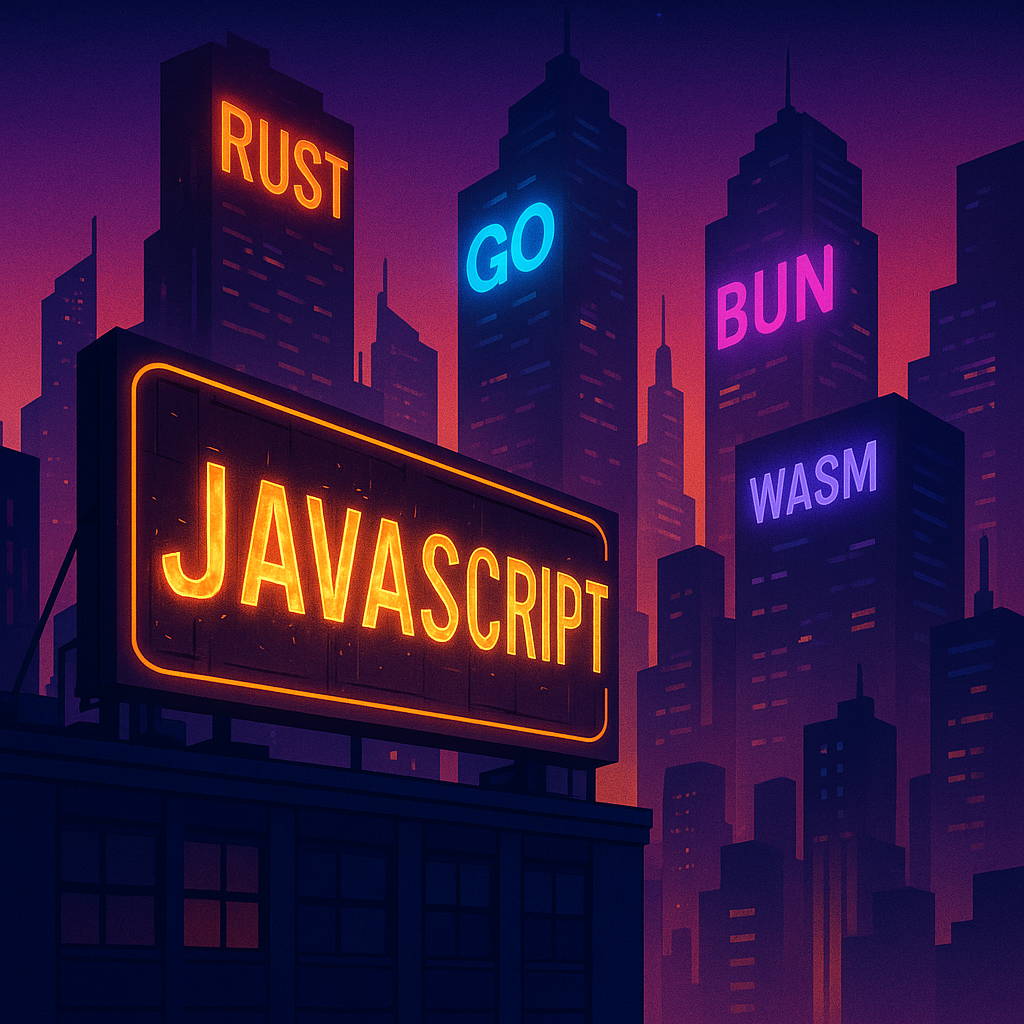
Image Credit: DALLE
When I first started coding in JavaScript, it felt alive. There was this electric sense of possibility — hack together a prototype in an afternoon, deploy it with a few npm installs, and ship something that worked.
But somewhere between Webpack configs, package vulnerabilities, and framework fatigue, that spark dimmed.
And over the past few years — especially inside my last startup — I’ve seen something quietly alarming: Developers aren’t excited about JavaScript anymore. They’re exhausted by it.
The Unspoken Fatigue of Modern JavaScript
When I joined my last company, our frontend team used React, TypeScript, Vite, Tailwind, ESLint, Prettier, Jest, and Cypress — before even writing a single line of business logic.
Every week, another package would break. Every month, a new framework would trend. Every year, our “tech debt” was just keeping up with the ecosystem.
It wasn’t that JavaScript stopped working. It’s that JavaScript stopped feeling simple.
The Modern JS Trap
- Too many tools, not enough stability.
- Too many frameworks, not enough progress.
- Too much configuration, not enough creation.
The irony? The language built for agility became a bureaucracy of build steps.
New coding paradigms
One of the earliest and most visible changeovers away from heavy reliance on JavaScript was seen in the online casino**** industry, where platforms began migrating to alternative coding frameworks to improve reliability and speed. With thousands of concurrent users placing bets, streaming live games, and interacting in real time, casinos quickly realized that performance bottlenecks and latency issues could erode user trust. By adopting more efficient back‑end technologies and streamlined front‑end frameworks, these platforms were able to deliver faster load times, smoother gameplay, and enhanced security—critical factors in retaining players and meeting regulatory standards. This shift highlighted how industries with high‑stakes, real‑time demands often serve as early adopters of new coding paradigms, paving the way for broader changes across the web ecosystem.
The Rise of Simpler (and Faster) Alternatives
While JavaScript teams wrestle with tooling sprawl, newer stacks are thriving by focusing on simplicity and speed:
1. Bun.js — The Rebel Runtime
Built in Zig, Bun executes JavaScript and TypeScript blazingly fast — no Node.js overhead, no extra tooling. It’s everything developers wish JS had been from the start.
2. Go & Rust — The Pragmatic Escape
Backend engineers are quietly leaving Node.js for Go and Rust because they compile faster, deploy smaller, and crash less.
At my previous startup, we migrated our API from Express to Go and saw a 70% reduction in response latency and a 90% drop in crash incidents.
3. Svelte & SolidJS — The Framework Rebellion
Frontend frameworks like Svelte and SolidJS are rejecting the bloated abstractions of React and Vue, offering smaller bundles and direct reactivity.
The result? Apps that feel lean again — and devs who can focus on the product, not the pipeline.
The Harsh Truth: It’s Not Just About Performance
JavaScript isn’t dying because of speed or syntax — it’s dying because of burnout.
When every new job asks for a different combination of Next.js, Remix, or Astro… When libraries deprecate faster than documentation can update… When you need five different tools to bundle a static site…
Developers start to check out.
One of my senior engineers — a guy who’s written JS since ES3 — told me something that stuck:
“I didn’t quit JavaScript because it was bad. I quit because it stopped feeling fun.”
That’s the quiet reality most teams don’t want to admit.
What’s Actually Replacing JavaScript
It’s not one language — it’s a philosophy shift.
- Less JavaScript, More Edge: Tools like Cloudflare Workers, Deno Deploy, and Vercel Edge Functions are pushing logic to the edge — small, isolated, deployable in seconds.
- Strong Typing Wins: TypeScript isn’t a safety net anymore; it’s a gateway drug to languages with real type systems like Go and Rust.
- WebAssembly (WASM): Slowly but surely, WASM is becoming the runtime neutralizer — letting C++, Rust, Zig, and Go all run inside browsers faster than native JS.
JavaScript won’t disappear overnight. But in five years, it may be the new “legacy language” — running quietly in the background while other runtimes take the stage.
What This Means for Developers
If you’re building a career around JavaScript, the shift isn’t a threat — it’s a signal.
- Double down on fundamentals: Learn how browsers, HTTP, and event loops actually work.
- Diversify your stack: Pick up a system language (Go, Rust, Zig) and a modern runtime (Bun, Deno).
- Focus on building, not tooling: Every time you spend 2 hours debugging your Webpack config, you’re burning creative energy.
The web doesn’t need more frameworks. It needs more makers.
The Final Thought
JavaScript isn’t dead yet — but it’s aging. It’s no longer the scrappy, rebellious language that powered the early web. It’s the corporate workhorse of the modern internet — stable, bloated, and slowly losing its soul.
The new wave of developers isn’t asking how to build another React app. They’re asking how to build something fast, simple, and fun again.
Maybe the future of JavaScript isn’t about saving it. Maybe it’s about letting it rest — and rediscovering what made coding magical in the first place.
Comments
Loading comments…